- ✓Pasta filata means 'spun paste' — the curd is stretched and kneaded in hot water after reaching a target pH.
- ✓The technique gives fibrous, elastic texture and excellent melting — essential for pizza cheeses.
- ✓The family ranges from fresh, salt-brined mozzarella to long-aged, complex provolones.
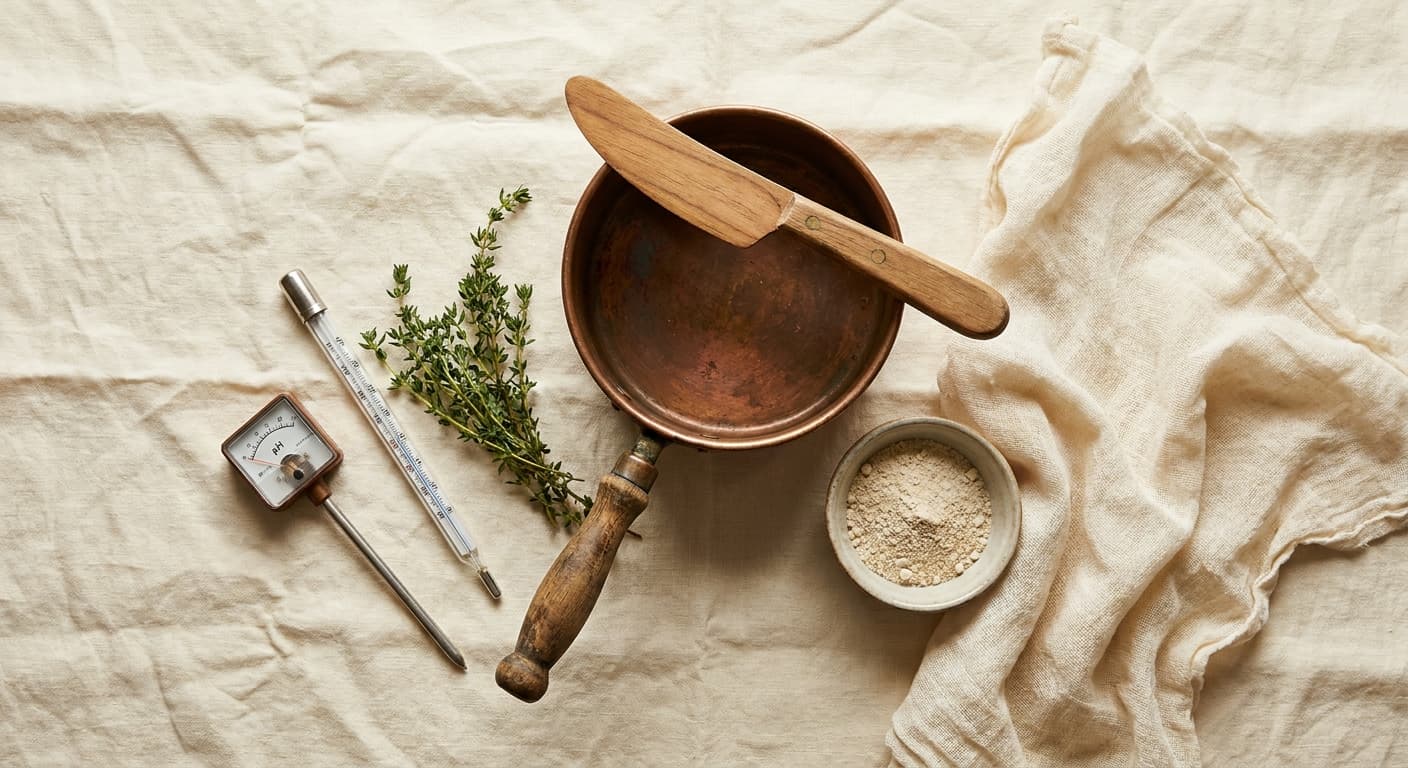
The technique in outline
Pasta filata cheeses are made like many semi-hard cheeses up to the point of draining the curd. From there, the curd is allowed to acidify — either in the whey or on a draining table — until it reaches pH 5.1–5.3. At that pH, the calcium-casein network is loose enough that the curd becomes plastic in hot water (around 75°C). The cheesemaker kneads and stretches it like dough, aligning the proteins into fibres, then shapes it into balls, braids, or flasks and brines it.
The pH window is narrow and critical
Pasta filata only works inside a tight pH window. Too high and the curd won't stretch — it tears or feels rubbery. Too low and the curd breaks into grainy pieces that can't be shaped. Traditional makers assess readiness by squeezing a warm sample to see if it strings, a skill that takes months to develop. Modern production tests pH directly. Missing the window means starting over.
Good pasta filata cheeses need starters that acidify aggressively. Thermophilic cultures — Streptococcus thermophilus paired with Lactobacillus helveticus or L. delbrueckii — are standard.
The spectrum of stretched-curd cheeses
- Fresh mozzarella — high moisture, short-brine, eaten within days. Fior di latte from cow's milk; mozzarella di bufala from water buffalo.
- Burrata — mozzarella pouch filled with stracciatella (cream and shredded mozzarella curd).
- Scamorza — drier, lightly aged, sometimes smoked.
- Provolone — larger wheels, longer aged, from mild dolce to sharp piccante.
- Caciocavallo — pear-shaped wheels traditionally tied in pairs and hung to age. Southern Italian staple.
- Oaxaca / Quesillo — Mexican tradition; curd stretched into ribbons and wound into balls.
Why pasta filata melts so well
The stretching step aligns casein fibres along one axis, similar to how kneading aligns gluten in bread dough. That alignment gives the cheese its characteristic stringy pull when torn or melted. Because the calcium-casein network is already partially disassembled by the acidification and heat, further heating (on a pizza, in a sandwich) slides it smoothly into flow rather than clotting into rubbery lumps. This is why mozzarella and provolone dominate melting-cheese applications.
Making mozzarella at home
A small batch of mozzarella takes about three hours. Use thermophilic starter, culture the milk well, add rennet, cut and stir briefly to firm the curd. Drain and let the curd acidify on the bench, turning occasionally, until it reaches pH 5.2 — usually three to five hours. Cut into strips, cover with water at 75°C, and stretch with a wooden paddle until smooth and glossy. Form into balls, cool in chilled brine. Eat within 48 hours for the classic texture.
Frequently asked
Can I use citric acid to make mozzarella instead of waiting for starter culture?+
You can, and 30-minute 'quick mozzarella' recipes use exactly this trick. It works mechanically — you hit the target pH immediately — but the flavour is flat because no starter bacteria have acted on the lactose. Fine for weekday pizza, not for a dinner party.
Why is my homemade mozzarella rubbery?+
Usually stretched at the wrong pH — too high in most home cases. Let the curd acidify longer before stretching, or pre-mill the curd and soak briefly in hot water to test stretch before committing the whole batch.