- ✓Cow's milk is the most versatile and forgiving — default for most styles.
- ✓Goat's milk coagulates faster and more delicately, and lends tangy, clean flavour.
- ✓Sheep's milk is protein- and fat-rich, with huge yield per volume and powerful flavour.
- ✓Buffalo milk is richest of the four — essential for true mozzarella di bufala.
Cow's milk: the workhorse
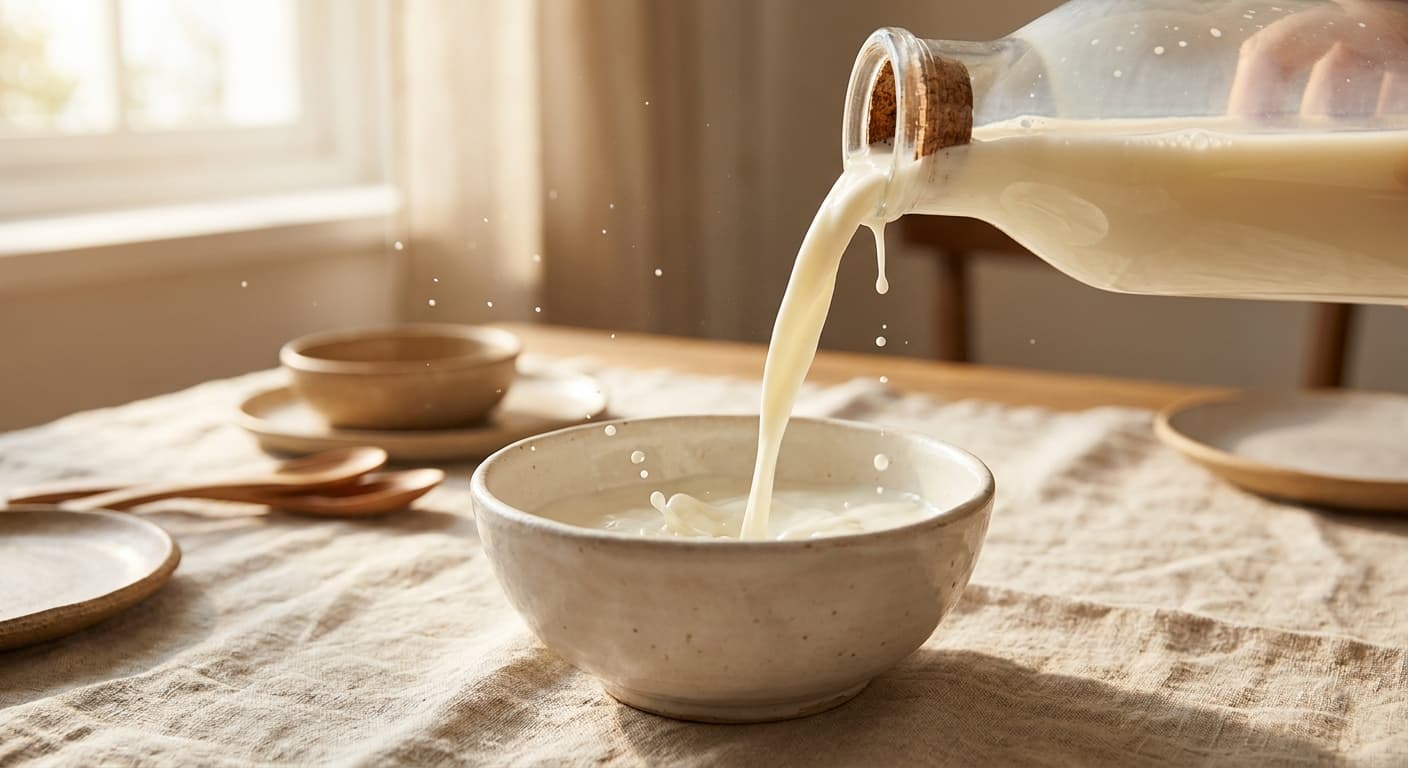
Cow's milk is the default of global cheesemaking — abundant, forgiving, and capable of virtually every style. At about 3.7% fat and 3.3% protein in whole milk, it offers a balanced base. The flavour profile is clean, with less of the goaty or lanolin-y notes of other milks. Holstein milk is high-volume and slightly lower in solids; Jersey and Guernsey milks are richer, more yellow, and make denser, more flavour-forward cheeses.
Goat's milk: delicate and distinctive
Goat's milk coagulates faster and with a softer, more fragile curd than cow's milk. The fat globules are smaller (and so naturally homogenised), which contributes to the lighter texture and milder fat feel of goat cheeses. The flavour has characteristic tangy, sometimes 'goaty' notes from short-chain caprylic and caproic acids — subtle in fresh cheeses, more pronounced in aged ones.
- Coagulates faster — reduce rennet dose by about 20% versus cow's milk.
- Soft curd — cut larger and handle more gently.
- Naturally whiter cheese — goat milk has no β-carotene, unlike cow's milk.
- Classic styles: chèvre (lactic-set), Crottin, Valençay, Banon, Garrotxa, aged goudas.
Sheep's milk: dense, rich, aromatic
Sheep's milk is the most concentrated of the common cheesemaking milks — often around 7% fat and 5.5% protein. That higher solids content means a much better yield per volume: a litre of sheep's milk produces close to twice as much cheese as a litre of cow's milk. It has a distinctive lanolin-like aroma, a creamy mouthfeel, and ages brilliantly into cheeses with deep umami and lingering finish.
Buffalo milk: the specialist
Water buffalo milk is the richest commonly used cheesemaking milk — around 7.5% fat and 4.5% protein, and a creamy white colour with no β-carotene. It's also less widely available, more expensive, and more variable than cow's milk. Most buffalo milk in the cheese world goes into mozzarella di bufala (the only authentic mozzarella, arguably) and its cousins; smaller quantities go into buffalo ricotta and aged buffalo cheeses like buffalo Gouda.
Practical adjustments by milk type
- Goat: reduce rennet slightly, cut curd larger, expect faster acidification with acid-set styles.
- Sheep: expect higher yield per volume, richer fat expression — slightly drier pressing often works well.
- Buffalo: fat is so high that fat loss in whey is a bigger concern — use finer cheesecloth and save whey fat for ricotta.
- Blended milks: adjust rennet and cook temperatures to the lower-fat component as a starting point.
Frequently asked
Can I use non-dairy 'milks' to make cheese?+
Plant-based products are a different category — they contain no casein and coagulate by completely different chemistry. 'Vegan cheese' is a worthy craft but it's not cheesemaking in the casein-coagulation sense. Different questions, different answers.
Does the breed of cow really matter?+
Yes, measurably. Jersey and Guernsey milk has higher fat and protein, more β-carotene (yellower cheese), and produces richer, denser cheese per volume than Holstein. Many traditional European cheeses specify particular breeds — this isn't snobbery; it's grounded in milk chemistry.