- ✓Breed genetics meaningfully change fat, protein, and casein composition — and therefore cheese yield and behaviour.
- ✓The A1/A2 beta-casein debate is real as a genetic fact but oversold on the health side.
- ✓Cheesemaking-focused breeds (Jersey, Brown Swiss, Montbéliarde) don't produce the most milk — they produce the most cheese.
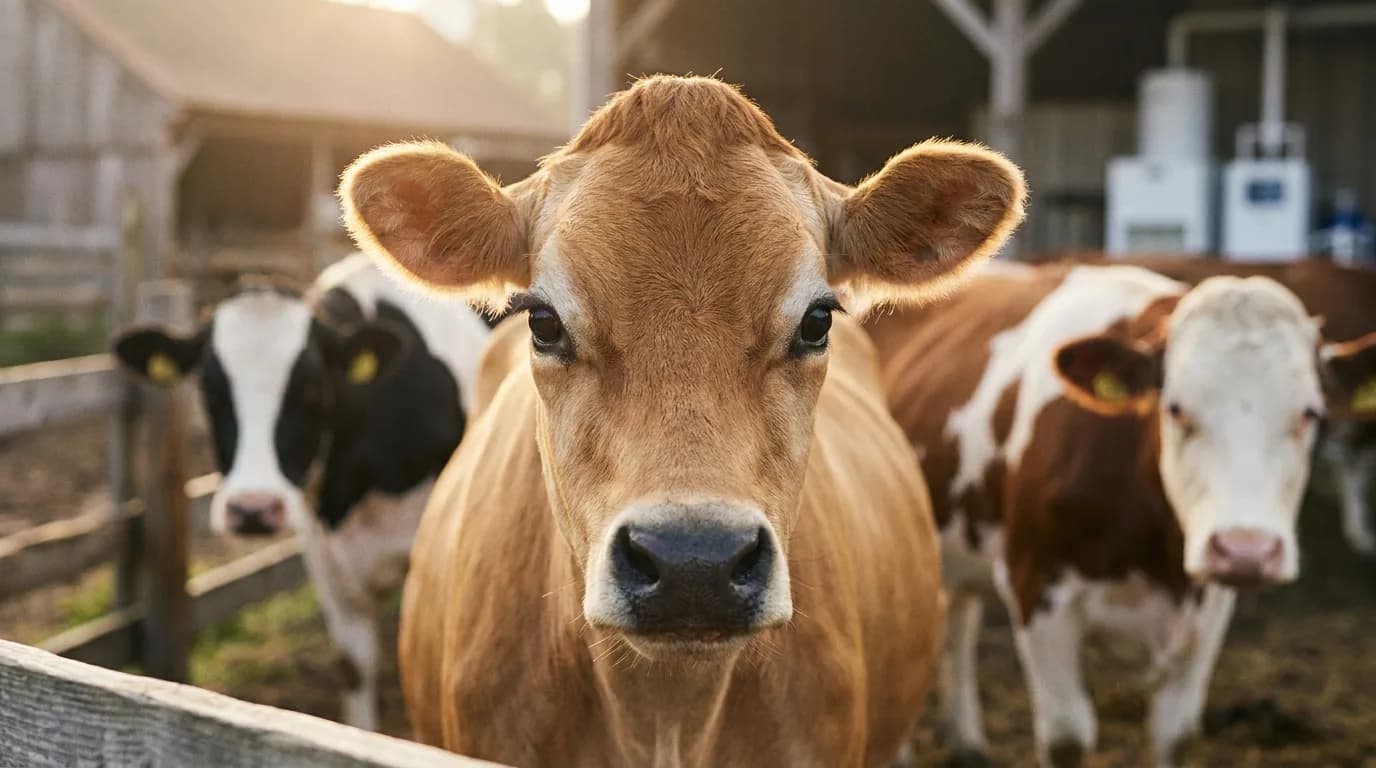
Breeds are not interchangeable
Holsteins produce a lot of milk. Jerseys, Brown Swiss, Guernseys, Normandes, and Montbéliardes produce less milk, but milk that is richer in fat, richer in casein, and — crucially — higher in total cheese yield per litre. A Jersey typically delivers 5–7% more cheese yield than a Holstein from the same volume, thanks to the combination of higher total casein and a higher proportion of casein variants (particularly BB κ-casein) that coagulate faster and tighter. Traditional cheese regions did not choose their breeds by accident; they chose the animals whose milk coagulated the way their style required.
Casein genetics: it's about variants, not averages
The four casein proteins (αS1, αS2, β, κ) each come in genetic variants — letters A, B, C, E, and others — that differ by one or a few amino acids. Most of the time the differences are invisible. But a handful of them change cheesemaking meaningfully. κ-casein B, for example, produces faster rennet coagulation, firmer gels, and higher curd yield than κ-casein A. Herds selected for cheese production rather than fluid milk production have historically drifted toward higher frequencies of the 'cheesemaking-friendly' alleles. This is selection biology, not marketing.
A1 vs A2 beta-casein: the honest version
The A1/A2 distinction refers to two variants of β-casein that differ by a single amino acid at position 67 — histidine (A1) versus proline (A2). A2 is the ancestral form. A1 arose by a point mutation estimated around 8,000 years ago and is now common in many European-origin breeds. The functional difference during digestion is that A1 β-casein can release a short peptide called beta-casomorphin-7 (BCM-7). A2 does not.
Health claims about A2 milk (less bloating, better tolerance, reduced risk of various conditions) remain contested. Some individuals report subjective improvement; large-scale clinical evidence is mixed and most national health bodies do not endorse the claims. The genetics are real. The medical story is, as of now, not settled.
What this means at the vat
For a cheesemaker, A1 vs A2 is not a major driver of cheesemaking behaviour — both coagulate fine, both age well, both produce excellent cheeses. If your customers are paying a premium for A2 milk, certify your supply and label accordingly. If they are not, focus on breed, lactation stage, and feed — those move the cheesemaking needle much more than the A1/A2 locus does.
Goats, sheep, and buffalo: species-level genetics
At the species level, the genetic differences are larger and the cheesemaking consequences are unmissable. Goats naturally carry a variant of αS1-casein that, in some breeds, is expressed at drastically reduced levels — which is part of why goat's-milk curd is softer and more fragile. Sheep carry casein alleles that push total protein much higher. Water buffalo milk has a distinct triglyceride profile and lacks β-carotene pigmentation, producing the signature pale, porcelain-white mozzarella di bufala. These are not breed tweaks — they are deep species divergences, and they drive why different cheese traditions evolved around different animals.
- Choosing a breed for cheese: prioritise total casein and κ-casein BB frequency over raw milk volume.
- Choosing a species: match the coagulation and fat profile to your intended style, not just your market.
- Crossbreeding (e.g. Montbéliarde × Holstein) is common for balancing yield and cheese-friendliness.
Frequently asked
Can I tell from the milk whether a herd has cheese-friendly casein variants?+
Not by eye. Genotyping is cheap now and increasingly standard in cheese-focused dairies. Ask your supplier — if they can't tell you, that itself is useful information about how selective the herd is.
Is crossbred milk worse for cheese?+
Not necessarily. Well-chosen crosses (especially adding Jersey or Montbéliarde into a Holstein herd) often produce excellent cheesemaking milk while keeping volume reasonable. What matters is the compositional outcome, not ideological purity.