Author
Cheese Lab
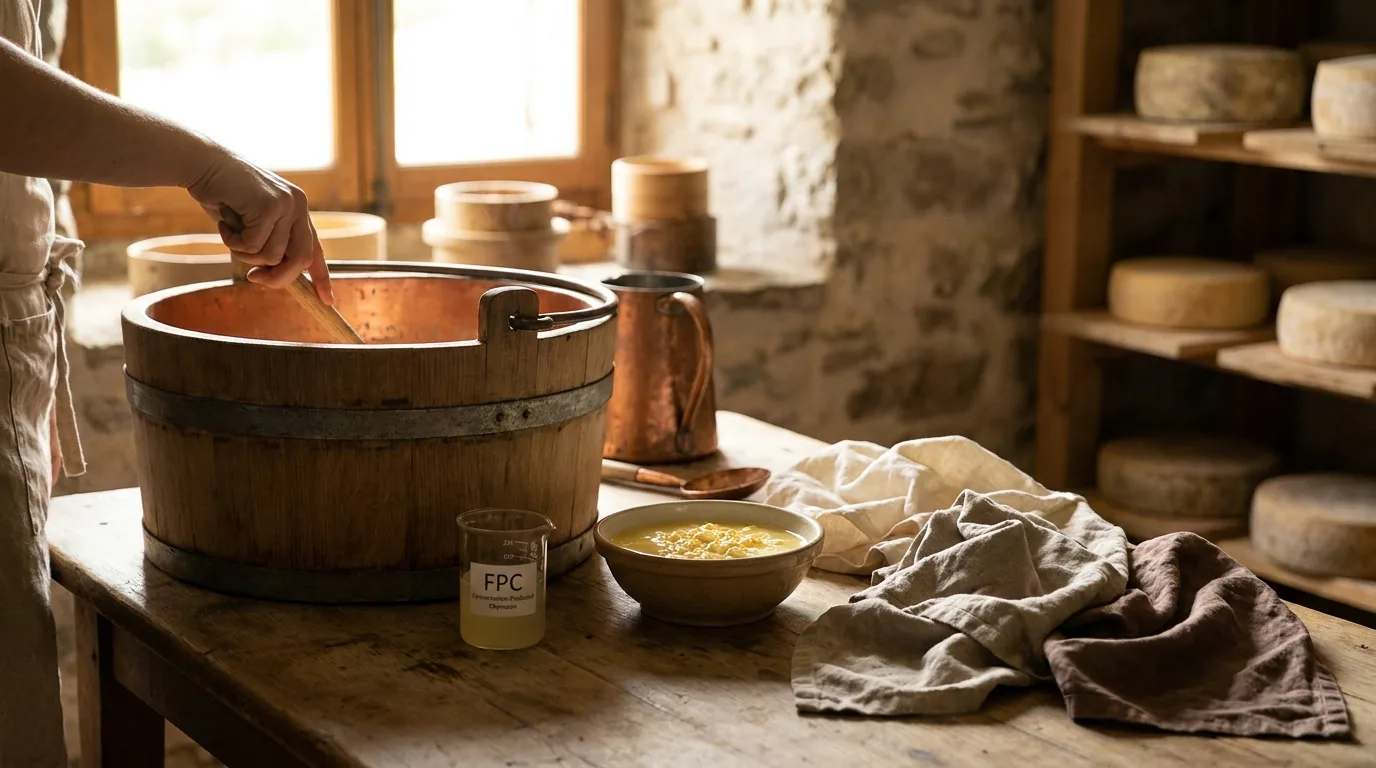
At a farmers' market cheese stall, someone asks the producer what rennet they use. The producer, honestly, answers "microbial" or "FPC" or sometimes "it's vegetarian-friendly now". The questioner is often surprised. Most cheese eaters still assume rennet comes from calves' stomachs, as it did for centuries.
It doesn't, in roughly 80% of the world's commercial cheese. The change happened quietly in the 1990s and has largely settled.
What actually replaced calf rennet
The dominant rennet today is called fermentation-produced chymosin (FPC). It is the exact same enzyme as calf chymosin — the same amino acid sequence, the same shape, the same cleavage site on κ-casein — but it is produced by fermentation rather than extraction from a slaughtered calf's fourth stomach.
The technology works by inserting the bovine chymosin gene into a microbial host — commonly Aspergillus niger var. awamori, Kluyveromyces lactis, or Escherichia coli K-12 — and fermenting that organism in an industrial tank. The microbe secretes chymosin into the broth. The broth is purified, the microbe is removed, and what remains is pure bovine chymosin identical to the calf-derived version. The first commercial product, Chy-Max, received FDA approval in 1990.
Why it won
- Consistency. A fermentation tank produces chymosin with the same purity and activity in every batch. Stomach extraction varies with the individual calf.
- Supply. Global cheese demand long outstripped the supply of veal calves. FPC scales with fermentation capacity, which scales with money.
- Vegetarian-acceptable. No animal is slaughtered for FPC. Most vegetarian organisations consider FPC-produced cheese vegetarian — though the cheese still contains milk, so it is not vegan.
- Cleaner proteolysis. Compared to older microbial rennets (from Rhizomucor miehei and relatives), FPC produces less bitterness during long ageing because it has the exact cleavage specificity of the native bovine enzyme.
- Cost. At industrial scale, FPC is considerably cheaper per unit of clotting activity than traditional rennet.
What it does not mean
Calf rennet is not extinct. Many traditional cheeses — Parmigiano Reggiano, Grana Padano, and several PDO French styles — are required by their designation to use animal rennet, and calf rennet is still produced. Vegetable coagulants (thistle, fig, nettle) also persist, mainly in Iberian and small artisan cheeses. Microbial rennets from R. miehei are still used, particularly in kosher and halal contexts where FPC hosts may be questioned.
For a home cheesemaker choosing rennet today, FPC is usually the practical default: consistent, affordable, widely available, and producing clean flavour. Traditional animal rennet remains a viable choice for traditional styles; vegetable rennet is a choice rather than a necessity.
The full story — hosts, history, and the precision fermentation of casein coming next — lives in Biotechnology in Cheesemaking.
Biotechnology is the invisible infrastructure of almost every modern vat. Most of it has already happened.