Sensory Concept
Garlic Moon
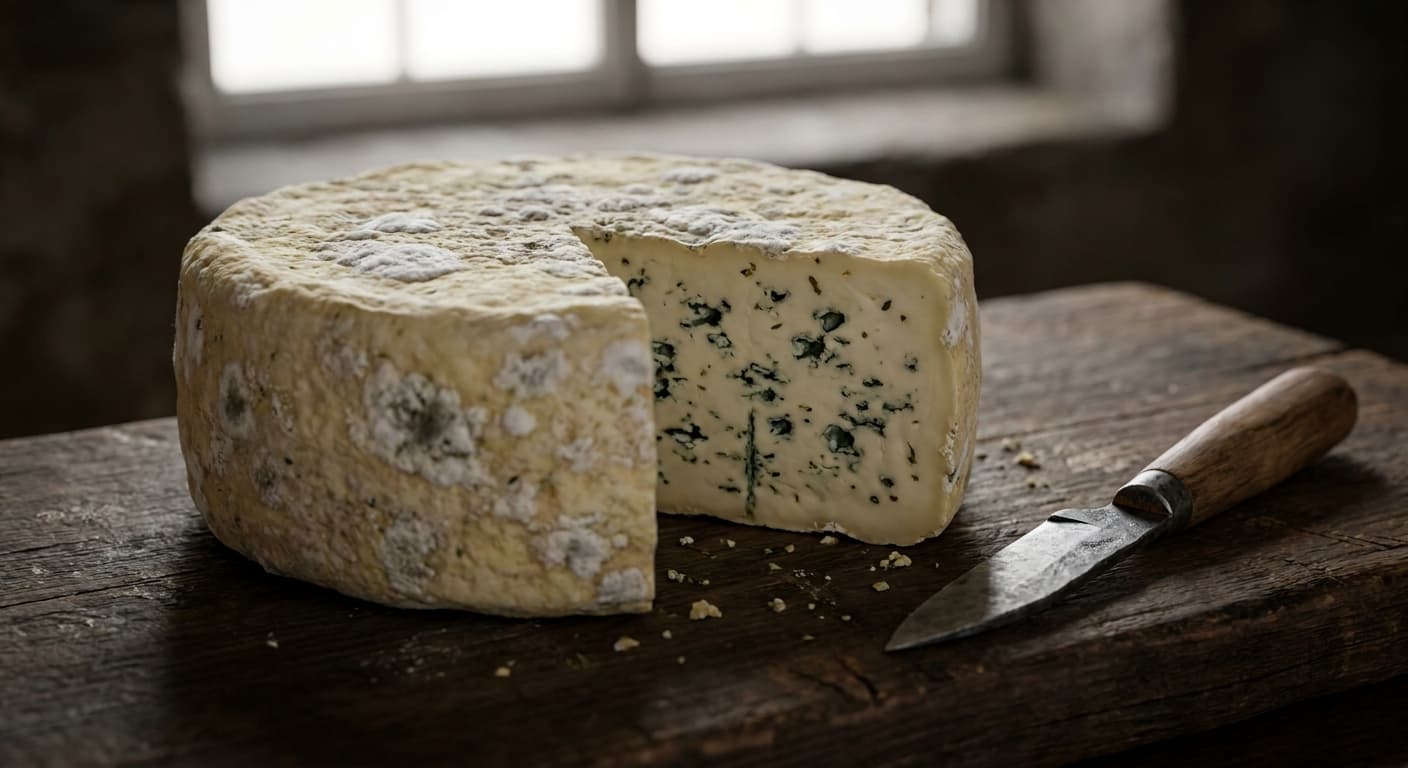
A rustic blue cheese with herb-flecked paste and pale natural rind, developing from ambient cellar moulds. The double-cream richness carries pungent garlic and herb aromatics through a creamy, slightly crumbly texture. Blue veining may develop unevenly depending on piercing technique and cave conditions, creating pockets of sharp, mineral intensity against the herbaceous backdrop.
Viability Assessment
This concept faces significant technical challenges. Blue cheese requires P. roqueforti inoculation and precise piercing technique — neither guaranteed by 'natural rind' aging. The herb-garlic additions may interfere with proper blue development and create unpredictable fermentation. While the double-cream base provides good fat content for blue cheese, achieving consistent blue character without deliberate mould inoculation is unreliable.
Evaluation breakdown
Scored across five dimensions of cheese viability
Double cream with herbs and garlic will produce rich, aromatic paste. However, true blue character requires specific conditions not guaranteed by natural aging.
Natural rind development conflicts with blue cheese requirements. Blue needs controlled P. roqueforti inoculation and piercing — not typically achieved through ambient moulds alone.
Mesophilic culture supports acidification, but blue veining requires P. roqueforti not present in the config. Garlic may create antimicrobial effects interfering with desired mould development.
Recipe includes blue mould inoculation to bridge the config gap, but 'natural rind' aging creates uncertainty about consistent blue development without controlled cave conditions.
Herb-garlic blue cheese has clear market appeal for artisanal customers. The concept is distinctive, though execution challenges may limit consistency.
Technical confidence
What's certain vs. what depends on specific maker control
Certain
Chemistry & physics facts — will happen given these inputs.
- •Mesophilic culture will acidify milk and support coagulation over 45-60 minutes at 30°C.
- •Animal rennet will form firm curd suitable for cutting and pressing.
- •Double cream milk will produce rich, high-fat paste with enhanced mouthfeel.
- •Herbs and garlic will distribute through the curd during cutting and pressing.
- •16 weeks aging will develop proteolysis, reducing moisture and intensifying flavors.
Likely
Probable with reasonable technique and control.
- •Paste will develop semi-firm to creamy texture with herb-garlic aromatics.
- •Natural rind will form pale, slightly fuzzy surface from ambient yeasts and moulds.
- •Salt will migrate inward over 4-6 weeks, balancing flavor development.
- •Some blue-green veining may develop if P. roqueforti takes hold and oxygen reaches interior.
- •Final wheel will weigh 400-480g with concentrated herb and garlic character.
Depends on action
Requires deliberate inoculation or specific conditions not in the config.
- •Consistent blue veining requires P. roqueforti inoculation at 0.02g per 4L milk and piercing at 2-3 weeks.
- •Proper blue development needs controlled humidity 85-90% and temperature 10-13°C, not ambient conditions.
- •Even blue distribution requires systematic piercing pattern every 2cm across wheel surface and depth.
- •Natural rind character depends on specific cave ecology — results vary significantly between aging environments.
Recipe & how to make it
Expected Yield
Approximate 400-480g finished wheel from 4L double cream milk, assuming 11-13% yield after aging losses
Mould Size
15cm diameter x 6cm height tomme mould with drainage holes
Salt Method · Precise
2% of green cheese weight applied as dry salt rub after pressing, approximately 10-12g total salt rubbed over surface and absorbed over 24 hours
Ingredients
- •4L double cream cow's milk
- •1/8 tsp MA 011 mesophilic culture
- •0.02g Penicillium roqueforti powder
- •2ml liquid calf rennet (single strength)
- •2 tbsp fresh herbs, finely chopped (thyme, rosemary, chives)
- •2 cloves garlic, minced very fine
- •Cheese salt for salting
Equipment
- •Large pot
- •Long knife for cutting curd
- •Slotted spoon
- •Cheesecloth
- •15cm diameter tomme mould
- •Cheese press or weights
- •Aging container with humidity control
- •Long piercing needle or skewer
Steps
- 1Heat milk to 30°C, add mesophilic culture, stir and ripen 45 minutes until pH 6.4-6.5.
- 2Add P. roqueforti dissolved in 2 tbsp cool water, stir gently.
- 3Add rennet, stir 30 seconds, cover and set 45-60 minutes until clean break.
- 4Cut curd into 1.5cm cubes, rest 10 minutes for syneresis.
- 5Gently mix in minced garlic and herbs, avoiding curd damage.
- 6Heat slowly to 35°C over 20 minutes, stirring occasionally.
- 7Drain whey when curds compact to 70% volume and pH reaches 6.2-6.3.
- 8Press in mould at 5kg for 12 hours, flip and press 10kg for 24 hours.
- 9Remove from press when pH 5.2-5.3 and wheel feels firm.
Critical Checkpoints
- ▸pH at cutting: 6.4-6.5 for proper curd formation
- ▸Clean break test: curd should split cleanly when knife inserted
- ▸Whey drainage: continue until pH 6.2-6.3 before pressing
- ▸Post-press pH: target 5.2-5.3 for proper aging acidification
- ▸Pierce at 2-3 weeks when rind forms, creating systematic holes for blue development
The science behind your cheese
Chemistry
Mesophilic lactococci convert lactose to lactic acid, lowering pH from 6.7 to 5.2-5.3. Animal rennet's chymosin cleaves kappa-casein, forming the protein network that traps fat globules from the double-cream base. Garlic's allicin compounds may create mild antimicrobial effects, potentially competing with desired mould development.
Physics
Curd syneresis expels whey through protein network contraction, concentrated by gentle heating to 35°C. Pressing consolidates the herb-studded curd matrix while expelling residual moisture. Salt migration creates osmotic gradients that further dehydrate the surface and regulate microbial activity.
Fermentation
MA 011 mesophilic culture provides primary acidification through Lactococcus lactis and cremoris strains. P. roqueforti, if successfully established, produces proteolytic and lipolytic enzymes creating blue-green veining and sharp flavors. However, garlic's antimicrobial compounds may interfere with consistent mould development.
Aging Process
Over 16 weeks, proteolysis breaks down casein proteins creating creamy texture development. Moisture loss concentrates herb and garlic flavors while surface moulds develop variably depending on cave conditions. Blue veining spreads through pierced channels if oxygen access and humidity support P. roqueforti growth.
The cheese playlist
5 songs to listen to while your cheese ages
Classic blue mood matching the cheese's blue aspirations and natural rind uncertainty
Herb-forward instrumental reflecting the herb infusion and rising complexity
Playful homage to the dominant garlic character threading through the cheese
Whimsical reference to the mould development challenges and aging process
Celebrating the natural rind development and authentic aging character
Sommelier's wine pairing
Recommended
Sauternes Château Coutet
Bordeaux, France
Why it works
The wine's residual sugar balances the sharp garlic bite while its acidity cuts through double-cream richness. Noble rot complexity complements the herb aromatics and potential blue funk.
The Science
Botrytis-concentrated sugars buffer the garlic's sulfur compounds while the wine's glycerol content matches the cheese's fat texture. Acetic acid from noble rot fermentation harmonizes with blue cheese proteolysis byproducts.
Serving suggestion
Best served at
18-20°C for optimal texture and aroma release without overwhelming garlic intensity
Accompaniments
Presentation
Serve at room temperature on wooden board with natural rind visible. Cut wedges showing herb distribution and any blue veining. Arrange accompaniments to balance rich, sharp, and sweet elements.
Configuration
The exact parameters used to design this cheese in the Lab.
Members · Export
PDF export is for members
Sign in for free to download the full analysis as a PDF.
Quote · Professor Whiskers
“Ah, Garlic Moon — the cheese equivalent of a passionate affair with a vampire hunter. Bold enough to clear a room, yet so alluring you risk it anyway. One wonders if the blue veining represents tears of joy or regret. Either way, it pairs excellently with self-doubt and red wine.”
— Professor Whiskers, Cheese Philosopher
Community feedback
Sign in to leave feedback or share how your cheese-making attempt went.
No feedback yet. Be the first to share your thoughts!