Sensory Concept
Garlic Grove
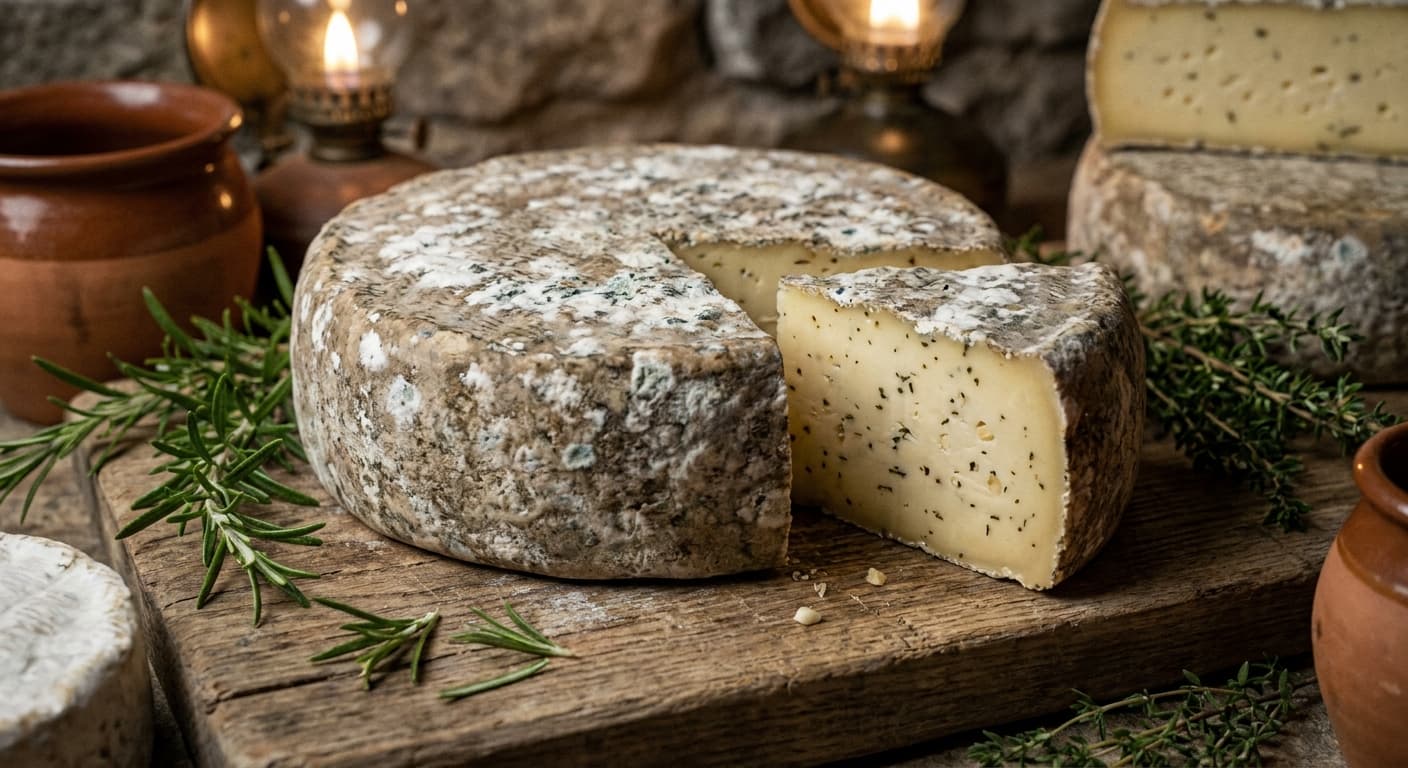
A semi-firm cow's milk wheel with a mottled natural rind of wild moulds and yeasts. The interior paste reveals flecks of herbs and garlic throughout, offering a firm yet yielding texture that breaks cleanly but springs back under pressure. The aroma balances herbaceous complexity with earthy cellar notes, while the flavour develops from initial garlic warmth to a deeper, nutty finish with hints of barnyard funk from 20 weeks of natural rind development.
Viability Assessment
This configuration represents a coherent semi-hard cheese concept with good commercial potential. The herb and garlic additions provide clear differentiation, while the natural rind and extended aging create complexity. Some uncertainty exists around consistent rind development without controlled inoculation, and the garlic intensity after 20 weeks depends on initial quantity and form used.
Evaluation breakdown
Scored across five dimensions of cheese viability
The described texture and flavour development align well with mesophilic culture acidification, animal rennet coagulation, and 20-week aging under natural rind conditions.
Achievable for intermediate makers with proper cellar conditions, though natural rind consistency requires either controlled cave environment or acceptance of batch variation.
Mesophilic culture and animal rennet work well together; natural rind development depends on ambient cave ecology which may vary significantly between environments.
Recipe supports the semi-hard texture and aging timeline, with clear incorporation method for add-ins and appropriate pressing schedule.
Herb and garlic additions create clear market differentiation, though natural rind may limit shelf stability compared to waxed alternatives.
Technical confidence
What's certain vs. what depends on specific maker control
Certain
Chemistry & physics facts — will happen given these inputs.
- •Mesophilic culture will acidify milk and support curd formation through lactic acid production.
- •Animal rennet will coagulate milk proteins into a firm, cuttable curd within 45-60 minutes.
- •Pressing will expel whey and consolidate curds into a cohesive wheel.
- •20 weeks aging will reduce moisture content and concentrate flavours through proteolysis.
- •Salt will migrate throughout the paste and inhibit undesirable bacterial growth.
Likely
Probable with reasonable technique and control.
- •Semi-firm texture will develop with some springiness and clean breaking characteristics.
- •Garlic and herb flavours will integrate into the paste but may mellow significantly over 20 weeks.
- •Natural rind will develop grey-brown colouration with mixed surface moulds.
- •Final moisture content will be approximately 42-46% after aging.
- •Yield will be approximately 8-10% of original milk weight after full aging.
Depends on action
Requires deliberate inoculation or specific conditions not in the config.
- •Consistent attractive natural rind requires stable cave conditions at 12-15°C and 85-90% humidity.
- •Preventing excessive surface mould growth may require periodic brushing or washing during aging.
- •Optimal garlic intensity requires using fresh minced garlic rather than dried, added at specific curd temperature.
- •Even herb distribution requires careful folding during curd formation, not surface application.
Recipe & how to make it
Expected Yield
Approximately 320-400g finished wheel from 4L whole milk, assuming typical 8-10% yield after 20 weeks aging
Mould Size
15cm diameter x 6-7cm height tomme or similar semi-hard cheese mould
Salt Method · Precise
1.5% refers to percentage of green cheese weight after pressing - apply as dry salt rub on all surfaces, allowing 2-4 hours absorption before beginning aging process
Ingredients
- •4L whole cow's milk
- •1/8 tsp MA 011 mesophilic culture (or equivalent Lactococcus lactis blend)
- •4ml single-strength liquid animal rennet (or manufacturer's recommended amount for 4L)
- •2-3 cloves fresh garlic, finely minced
- •2 tbsp mixed dried herbs (thyme, oregano, rosemary - finely chopped)
- •Sea salt for dry salting
Equipment
- •Large heavy-bottomed pot
- •Long knife for cutting curds
- •Wooden spoon
- •Fine mesh strainer
- •15cm diameter tomme mould
- •Cheese press or heavy weight system
- •Aging cave or temperature-controlled space
Steps
- 1Heat milk to 32°C and maintain temperature throughout process
- 2Dissolve culture in small amount of cooled boiled water, add to milk and stir gently
- 3Cover and ripen milk for 45-60 minutes until pH reaches 6.4-6.5
- 4Add diluted rennet, stir for 30 seconds, cover and set for 45-60 minutes until clean break
- 5Cut curds into 12mm cubes and let rest 10 minutes for whey release
- 6Gently heat curds to 38°C over 20-30 minutes, stirring occasionally
- 7Test curds - they should shrink to 70% original size and spring back when squeezed
- 8Drain whey until curds are barely covered, add minced garlic and herbs, fold gently to distribute
- 9Transfer seasoned curds to mould, pressing initially at light pressure for 2 hours
- 10Remove, flip, and press at full pressure (20-25kg) for 12-16 hours
- 11Remove from mould and dry salt at 1.5% of green cheese weight (typically 8-12g total salt)
- 12Age at 12-15°C and 85-90% humidity, turning every 2-3 days initially, then weekly
Critical Checkpoints
- ▸Milk pH at rennet addition: 6.4-6.5 (typically 45-60 minutes after culture addition)
- ▸Curd firmness test: clean break with whey separation when finger inserted
- ▸Cooking endpoint: curds shrunk to 70% size, firm but springy when squeezed
- ▸Pre-salting pH: 5.2-5.4 measured in pressed wheel
- ▸Surface mould check: brush weekly if excessive fuzzy growth develops
The science behind your cheese
Chemistry
Mesophilic lactococci convert lactose to lactic acid, lowering pH from 6.6 to approximately 5.2-5.4, creating optimal conditions for rennet activity and calcium-casein network formation. During 20-week aging, proteolytic enzymes from the culture and residual rennet break down casein proteins, developing characteristic nutty flavours while salt migration creates flavour balance.
Physics
Syneresis expels whey through mechanical cutting and gentle heating, concentrating solids into a semi-firm matrix. The natural rind forms through moisture loss at the surface, creating a protective barrier that regulates continued moisture migration while allowing gas exchange for proper aging.
Fermentation
The mesophilic culture performs primary acidification without requiring elevated temperatures, producing clean lactic flavours. Secondary fermentation during aging involves proteolysis and limited lipolysis, though significant flavour complexity would benefit from additional surface or internal mould cultures not specified in this configuration.
Aging Process
Twenty weeks allows substantial moisture loss (typically 15-25% weight reduction) while proteolysis develops texture from firm-elastic to semi-hard with some granularity. Natural surface moulds contribute earthiness but specific character depends on cave microflora - Penicillium nalgiovense, Geotrichum candidum, and various yeasts may appear but cannot be guaranteed without inoculation.
The cheese playlist
5 songs to listen to while your cheese ages
Earthy, organic soundscape mirrors the herb-infused complexity and natural aging process
Playful folk song celebrating the bold, rustic character of the primary flavour addition
Sophisticated jazz-rock reflects the patient cave aging and development of complex flavours
Traditional herb song connects to the countryside origins and natural rind development
Alternative rock about time's transformative power matches the 20-week maturation process
Sommelier's wine pairing
Recommended
Côtes du Rhône Rouge (Grenache-Syrah blend)
Rhône Valley, France
Why it works
The wine's herbal garrigue notes (wild thyme, rosemary) create aromatic harmony with the cheese's herb additions, while moderate tannins provide structure without overwhelming the semi-firm texture. The wine's earthy undertones complement the natural rind's barnyard funk.
The Science
Moderate tannins bind with milk proteins creating palate-cleansing astringency, while the wine's natural acidity cuts through butterfat. Volatile esters in aged Rhône wines (particularly from Syrah) share aromatic compounds with aged cheese, creating synergistic flavour amplification rather than competition.
Serving suggestion
Best served at
18-20°C serving temperature allows the semi-firm texture to soften slightly while bringing forward the integrated garlic and herb flavours that may be muted when cold
Accompaniments
Presentation
Serve at room temperature on a wooden board, cut into triangular wedges showing the herb-flecked interior. Arrange with accompaniments in small ceramic bowls, allowing the natural rind's rustic appearance to anchor the display.
Configuration
The exact parameters used to design this cheese in the Lab.
Members · Export
PDF export is for members
Sign in for free to download the full analysis as a PDF.
Quote · Professor Whiskers
“Ah yes, another human who thinks adding garlic to cheese makes them worldly. Twenty weeks of aging, and still they cannot age as gracefully as I, who perfects the art of doing absolutely nothing. At least this wheel has the dignity of a proper natural rind - unlike my pristine coat, it honestly shows its wrinkles.”
— Professor Whiskers, Cheese Philosopher
Community feedback
Sign in to leave feedback or share how your cheese-making attempt went.
No feedback yet. Be the first to share your thoughts!