Sensory Concept
Cendré des Bergers
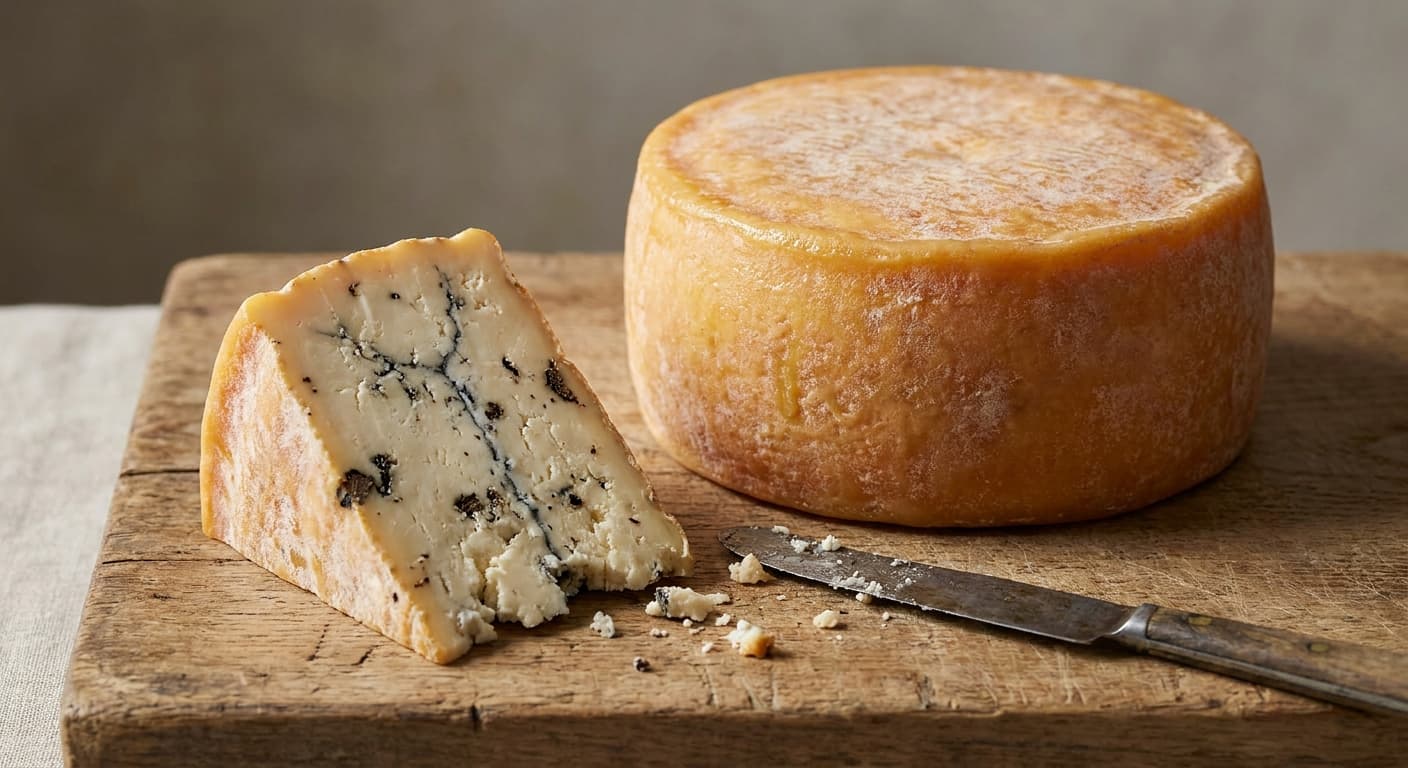
A distinctive sheep's milk cheese with an ash-veined ivory paste punctuated by shaved truffle. The smear-ripened rind develops a golden-orange bacterial bloom with yeasty, meaty aromas. The texture is semi-firm yet yielding, with earthy truffle notes balanced by the tangy complexity of sheep's milk and the mineral accent of ash streaks.
Viability Assessment
This is a coherent artisanal concept that leverages sheep's milk's natural affinity for smear cultures. The truffle and ash additions are technically compatible with the aging period and bacterial environment. However, truffle aroma will likely mellow significantly over 10 weeks, and consistent smear development requires careful humidity control and regular washing.
Evaluation breakdown
Scored across five dimensions of cheese viability
Sheep's milk naturally supports robust flavour development, and smear cultures create the described orange rind character. Truffle will integrate but fade somewhat over 10 weeks.
Achievable for intermediate makers with proper humidity control equipment. Smear-ripening requires consistent surface washing and environmental management.
Mixed meso/thermo cultures work well with sheep's milk proteins. Smear bacteria and yeasts will establish on the washing schedule if properly inoculated.
Recipe includes necessary smear culture inoculation and washing protocol. Ash and truffle integration is straightforward during pressing.
Distinctive positioning with premium ingredients appeals to artisanal market. Truffle commands higher price point though aroma may be subtle after aging.
Technical confidence
What's certain vs. what depends on specific maker control
Certain
Chemistry & physics facts — will happen given these inputs.
- •Mixed mesophilic and thermophilic cultures will acidify sheep's milk and form a cohesive curd structure.
- •Microbial rennet will coagulate sheep's milk proteins within 45-75 minutes at target temperature.
- •Ash will create visible mineral veining throughout the paste without affecting structural integrity.
- •10 weeks of aging will reduce moisture content and concentrate flavours through proteolysis.
- •Salt will migrate inward from the surface, creating a gradient that supports rind development.
Likely
Probable with reasonable technique and control.
- •Smear cultures will develop orange-pink surface coloration with proper washing and humidity control.
- •Sheep's milk will contribute characteristic tangy, mineral notes that intensify with aging.
- •Truffle particles will integrate into the paste but lose some volatile aromatics over 10 weeks.
- •Semi-firm texture will develop with some flexibility, typical of washed sheep's milk cheeses.
- •Finished wheels will weigh approximately 350-420g from 4L of whole sheep's milk.
Depends on action
Requires deliberate inoculation or specific conditions not in the config.
- •Consistent smear rind requires inoculating wash water with Brevibacterium linens and Debaryomyces hansenii.
- •Regular surface washing every 2-3 days with 2% salt solution maintains proper rind moisture.
- •Aging environment must maintain 85-90% humidity and 12-14°C temperature consistently.
- •Quality truffle preservation requires using fresh shaved truffle mixed immediately before pressing.
Recipe & how to make it
Expected Yield
350-420g finished wheel from 4L sheep's milk, approximately 9-10% final yield
Mould Size
15cm diameter x 8cm height cylindrical mould
Salt Method · Precise
1.5% refers to dry salt applied as percentage of green cheese weight immediately after pressing, plus ongoing 2% salt washes
Ingredients
- •4L whole sheep's milk
- •1/8 tsp Choozit MA 011 mesophilic culture
- •Pinch of Choozit TM 81 thermophilic culture
- •3-4ml microbial rennet (Rhizomucor miehei-derived)
- •15g fine sea salt for initial salting
- •2 tsp food-grade activated charcoal ash
- •8-10g fresh black truffle, finely shaved
- •Brevibacterium linens culture for wash (1g)
- •Debaryomyces hansenii yeast culture for wash (0.5g)
Equipment
- •Large heavy-bottomed pot
- •Long knife for cutting curds
- •Fine mesh strainer
- •15cm diameter cheese mould
- •Cheese press or weights (4-6kg pressure)
- •Aging cave or controlled environment (12-14°C, 85-90% RH)
- •pH strips or meter
Steps
- 1Warm sheep's milk to 32°C and add both cultures, stir gently and ripen for 45-60 minutes until pH reaches 6.4-6.5
- 2Add diluted microbial rennet, stir for 30 seconds, cover and allow to set for 45-75 minutes until clean break
- 3Cut curds into 1cm cubes, rest 10 minutes, then slowly heat to 38°C over 20 minutes while gently stirring
- 4Continue cooking curds until they shrink and release whey, testing for firm squeeze with slight spring-back
- 5Drain whey to curd level, mix in shaved truffle and ash evenly throughout curds
- 6Transfer to mould, press at light pressure (2kg) for 4 hours, flip and press at 4kg for 12 hours
- 7Remove from press, dry salt all surfaces (approximately 1.5% of green cheese weight)
- 8Place in aging environment, wash every 2-3 days with 2% salt solution inoculated with smear cultures
- 9Age 10 weeks, turning daily initially then every 2-3 days, maintaining surface moisture
Critical Checkpoints
- ▸Culture ripening: pH should drop from 6.7 to 6.4-6.5 before renneting
- ▸Coagulation: clean break test with knife insertion after 45-75 minutes
- ▸Curd cooking: curds should expel whey and spring back when squeezed gently
- ▸Pressing complete: cheese should be cohesive with smooth surfaces
- ▸Smear development: orange-pink coloration should appear within 7-10 days of washing
The science behind your cheese
Chemistry
The mixed culture combination creates both lactic acid (mesophilic lactococci) and assists protein breakdown through thermophilic enzymes. Sheep's milk's higher protein and fat content provides substrate for extensive proteolysis during aging, while the microbial rennet contributes ongoing protein modification throughout the 10-week period.
Physics
Smear-ripening creates a moisture gradient from the washed surface inward, supporting bacterial growth while the interior paste loses moisture more slowly. The ash particles create local pH variations that influence protein aggregation, while truffle oils gradually migrate through the paste matrix via diffusion.
Fermentation
Brevibacterium linens and associated yeasts on the surface create proteolytic enzymes that break down casein from the outside in, developing the characteristic tangy, meaty flavours. The surface washing maintains the slightly alkaline conditions needed for smear bacteria while the interior remains acidic from lactic fermentation.
Biology · Lactation & Milk
Sheep's milk contains higher concentrations of αs2-casein and β-casein compared to cow's milk, creating a firmer curd structure that supports the semi-firm texture. The smaller fat globules and higher mineral content typical of sheep breeds like East Friesian or Lacaune contribute to the characteristic tangy flavour profile that complements smear development.
Biology · Microbial
The mesophilic lactococci are homofermentative, producing primarily lactic acid and lowering pH efficiently, while the thermophilic component likely includes Streptococcus thermophilus for enhanced proteolytic activity. Brevibacterium linens grows optimally in the alkaline surface environment created by washing, producing methanethiol and other sulfur compounds that create the characteristic smear aroma.
Biology · Biotechnology
The microbial rennet is produced by Rhizomucor miehei fermentation, providing chymosin-like activity but with different temperature stability and proteolytic patterns compared to animal rennet. This affects the specific protein breakdown pathways during aging, potentially creating a slightly different texture development compared to traditional animal rennet versions.
Aging Process
Ten weeks allows significant protein breakdown in sheep's milk's dense casein network, developing complexity while maintaining structural integrity. Surface cultures peak around 6-8 weeks, then stabilize, while interior moisture drops from approximately 55% to 45%.
Safety audit
Biology-driven hazard check for this configuration
Smear-ripened surface with high moisture and pH near neutral
CAUTIONMechanism: Listeria monocytogenes has documented affinity for moist, alkaline cheese surfaces typical of washed-rind environments, particularly with sheep's milk which provides rich protein substrates.
Mitigation: Source pasteurized sheep's milk, maintain strict surface sanitation during washing, and ensure consistent refrigerated aging temperatures. Test wash water pH to keep below 7.2.
Fresh truffle addition in aged cheese matrix
INFOMechanism: Fresh truffle carries soil microorganisms, but the salt levels, pH below 5.5 in the paste interior, and 10-week aging period provide multiple antimicrobial hurdles that prevent pathogen establishment.
Mitigation: Clean truffles thoroughly before shaving and ensure even distribution during pressing to avoid moisture pockets.
The cheese playlist
5 songs to listen to while your cheese ages
The earthy, rustic complexity mirrors the cheese's pastoral sheep's milk origins with sophisticated truffle undertones
The ash veining and deep, grounded flavours echo the song's intensity and mineral darkness
Celtic pastoral themes reflect traditional sheep's milk cheesemaking heritage
Funky bass lines mirror the earthy funk of smear-ripened rind development
The vibrant orange smear rind and optimistic complexity of flavour development
Sommelier's wine pairing
Recommended
Châteauneuf-du-Pape Blanc Roussanne blend
Southern Rhône, France
Why it works
The wine's mineral complexity and subtle oxidative notes complement the sheep's milk tang and truffle earthiness, while the full body matches the cheese's rich mouthfeel and smear culture intensity.
The Science
The wine's moderate acidity cleaves through milk fat while its phenolic compounds from skin contact interact with the cheese's proteolyzed casein fragments. The shared terroir minerality creates aromatic harmony between wine and truffle components.
Serving suggestion
Best served at
Serve at 16-18°C to allow the sheep's milk fats to soften and release aromatic compounds while maintaining paste structure
Accompaniments
Presentation
Cut into wedges showing the ash veining, arrange on wooden board with truffle shavings visible in the paste cross-section
Configuration
The exact parameters used to design this cheese in the Lab.
Members · Export
PDF export is for members
Sign in for free to download the full analysis as a PDF.
Quote · Professor Whiskers
“Ah, the eternal paradox of the smear-ripened soul - we wash ourselves daily yet somehow become more pungent with age. Like this cheese, I too am covered in a beneficial bacterial film that others find 'aromatic.' The truffle addition is particularly pretentious - imagine burying your finest qualities in ash, only to have them discovered by creatures with superior noses. *licks paw dismissively*”
— Professor Whiskers, Cheese Philosopher
Community feedback
Sign in to leave feedback or share how your cheese-making attempt went.
No feedback yet. Be the first to share your thoughts!