Sensory Concept
Cendre Bleue
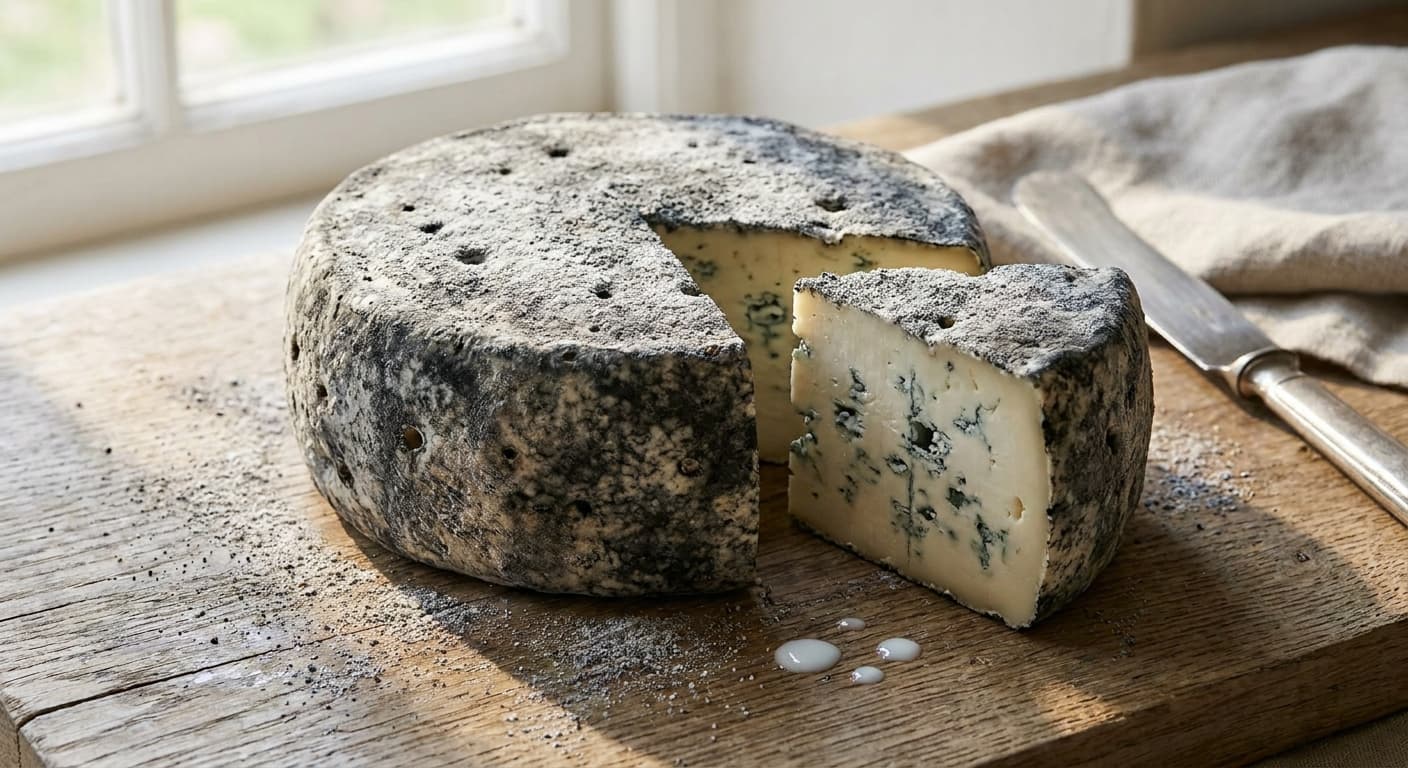
A distinctive ash-dusted sheep's milk blue wheel with natural grey-black rind mottling. The ivory paste develops irregular blue-green veining over 9 weeks, creating a creamy yet crumbly texture with earthy, mineral notes from the ash interplaying with the sweet, lanolin richness of sheep's milk and mild blue piquancy.
Viability Assessment
This is a technically coherent but challenging concept. The combination of natural rind development and blue veining creates competing microbial environments that require careful balancing. The ash addition is sensible with sheep's milk, but achieving consistent blue character without controlled piercing and humidity management will be difficult for most makers.
Evaluation breakdown
Scored across five dimensions of cheese viability
Sheep's milk, ash, and blue mould create a plausible flavour profile, though the natural rind may compete with blue development.
Natural rind blue cheese is achievable but requires specific cave conditions and careful moisture management that many artisanal makers lack.
Natural rind moulds and blue mould can coexist but may compete for resources, potentially leading to inconsistent blue development.
Recipe properly includes P. roqueforti and piercing steps necessary for blue development alongside natural rind management.
Sheep's milk blues have niche appeal, and the ash element adds visual distinction, but inconsistent results may limit market acceptance.
Technical confidence
What's certain vs. what depends on specific maker control
Certain
Chemistry & physics facts — will happen given these inputs.
- •Mesophilic cultures will acidify the milk and lower pH to support curd formation.
- •Animal rennet will coagulate casein proteins within 45-60 minutes at proper temperature.
- •Ash will raise surface pH and encourage mould development on the rind.
- •Syneresis will expel whey as curds acidify and are cut into small pieces.
- •Aging will reduce moisture content and concentrate flavours over 9 weeks.
Likely
Probable with reasonable technique and control.
- •P. roqueforti will develop blue-green veining if adequate oxygen access is maintained through piercing.
- •Natural surface moulds will establish on the ash-dusted rind creating grey-black mottling.
- •Texture will develop from initially crumbly to somewhat creamy as proteolysis progresses.
- •Sheep's milk will contribute characteristic sweet, nutty, and slightly lanolin flavours.
- •Final moisture content will be approximately 42-45% with proper aging conditions.
Depends on action
Requires deliberate inoculation or specific conditions not in the config.
- •Consistent blue veining requires maintaining 85-90% humidity and regular piercing every 2 weeks.
- •Balanced rind development needs cave temperature of 10-12°C to prevent surface moulds from overwhelming blue culture.
- •Even ash distribution requires careful application during the initial pressing phase.
- •Preventing excessive ammonia development depends on adequate air circulation during aging.
Recipe & how to make it
Expected Yield
350-420g finished wheel from 4L sheep's milk, assuming 9-11% yield after aging
Mould Size
15cm diameter x 7cm height tomme mould with drainage holes
Salt Method · Precise
Saturated brine (23% w/v) for 8 hours, targeting approximately 2% final cheese salt content
Ingredients
- •4L whole sheep's milk
- •1/8 tsp MA 011 mesophilic culture
- •1/8 tsp Penicillium roqueforti powder
- •2ml liquid animal rennet (single strength)
- •2 tsp food-grade wood ash
- •Non-iodized salt for brining
Equipment
- •Large pot
- •Long knife for cutting curds
- •Fine mesh strainer
- •Cheese cloth
- •15cm diameter tomme mould with drainage holes
- •Follower and weight for pressing
- •Sterile knitting needle or cheese piercer
- •Aging cave or refrigerator at 10-12°C, 85-90% humidity
Steps
- 1Heat milk to 32°C and add mesophilic culture, stir gently and ripen for 45 minutes.
- 2Add P. roqueforti dissolved in 2 tbsp cool water, stir thoroughly for 30 seconds.
- 3Add rennet diluted in 2 tbsp cool water, stir for 30 seconds, cover and let set 45-60 minutes until clean break.
- 4Cut curds into 1cm cubes, let rest 10 minutes for whey release.
- 5Gently heat curds to 35°C over 15 minutes, stirring occasionally.
- 6Continue stirring until curds shrink and pH reaches 6.4-6.5, typically 30-45 more minutes.
- 7Drain whey and transfer curds to cheese cloth-lined mould.
- 8Dust surface evenly with 1 tsp wood ash, flip, and dust other side with remaining ash.
- 9Press at 2kg weight for 12 hours, flip and press another 12 hours.
- 10Remove from mould and place in saturated brine (23% w/v) for 8 hours to achieve approximately 2% final salt content.
- 11Air dry on bamboo mat for 24-48 hours until surface is slightly tacky.
- 12Pierce wheel all over with sterile needle to depth of 2-3cm, creating holes every 2cm.
- 13Age at 10-12°C, 85-90% humidity, turning every 3 days for first 2 weeks.
- 14Re-pierce after 2 weeks, then age with weekly turning for remaining 7 weeks.
Critical Checkpoints
- ▸Clean break test: curd should split cleanly without releasing whey when knife is inserted
- ▸pH at draining: 6.4-6.5 to ensure proper texture development
- ▸Proper ash distribution: even dusting without clumping or bare spots
- ▸Adequate piercing: holes every 2cm to ensure oxygen reaches P. roqueforti
- ▸Humidity maintenance: 85-90% throughout aging to prevent rind cracking
The science behind your cheese
Chemistry
Mesophilic lactococci convert lactose to lactic acid, lowering pH and enabling casein coagulation. The ash raises surface pH, encouraging mould growth while contributing mineral complexity. P. roqueforti produces proteolytic enzymes that break down proteins, creating the creamy texture characteristic of blue cheese.
Physics
Syneresis expels whey as the protein matrix contracts under acidification and mechanical cutting. Salt migration from brining creates osmotic pressure that further expels moisture. The piercing creates channels for oxygen diffusion, essential for P. roqueforti's aerobic metabolism and blue pigment production.
Fermentation
MA 011 mesophilic culture produces lactic acid and develops the foundational cheese matrix. P. roqueforti requires oxygen for growth and blue pigment formation, competing with natural rind moulds for surface colonization. The interplay between these microbial populations determines final flavour balance.
Aging Process
Over 9 weeks, proteolysis gradually breaks down casein, creating amino acids that contribute umami depth. Lipolysis releases free fatty acids from sheep's milk fat, intensifying the characteristic nutty, slightly gamey notes. Moisture migrates from interior to surface, supporting both blue mould metabolism and natural rind development.
The cheese playlist
5 songs to listen to while your cheese ages
The melancholy electronic pulse mirrors the patient, methodical development of blue veining
Reflects the ash dusting and the ephemeral nature of natural rind development
Captures the pastoral sheep's milk terroir and golden aging process
The piercing creates breathing holes essential for blue development
Nine weeks of patient aging transforms simple milk into complex cheese
Sommelier's wine pairing
Recommended
Coteaux du Layon Chenin Blanc
Loire Valley, France
Why it works
The natural acidity and honeyed sweetness of late-harvest Chenin Blanc creates perfect counterpoint to the salty, mineral ash notes while complementing the rich sheep's milk fat and tempering the blue mould's piquancy.
The Science
The wine's residual sugars bind with salt receptors, reducing perceived saliness, while its tartaric acid cuts through sheep's milk fat. The honeyed esters harmonize with the cheese's proteolysis-derived amino acids, creating umami synergy without overwhelming the delicate P. roqueforti character.
Serving suggestion
Best served at
Remove from refrigeration 45 minutes before serving to reach 16-18°C, allowing the sheep's milk fat to soften and release full aromatics
Accompaniments
Presentation
Serve on slate or dark wood board to contrast the ash-dusted rind, cut into wedges just before serving to preserve the blue veining pattern
Configuration
The exact parameters used to design this cheese in the Lab.
Members · Export
PDF export is for members
Sign in for free to download the full analysis as a PDF.
Quote · Professor Whiskers
“Ah yes, another human attempt to improve upon milk by burying it with ash and poking holes in it for two months. Rather like my approach to the litter box, really, though I suspect my version has more consistent results. At least the sheep had the good sense not to witness this transformation.”
— Professor Whiskers, Cheese Philosopher
Community feedback
Sign in to leave feedback or share how your cheese-making attempt went.
No feedback yet. Be the first to share your thoughts!