Sensory Concept
Cellar Guardian
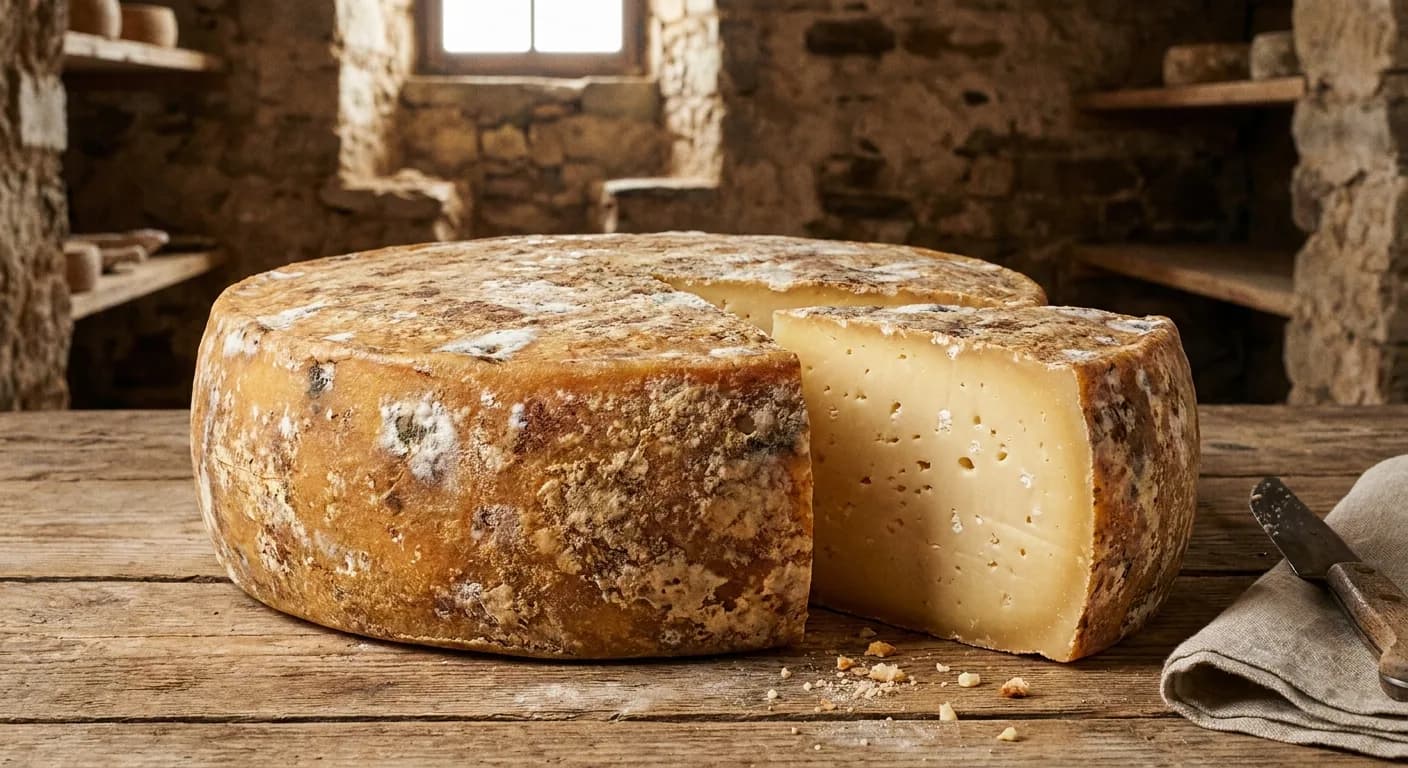
A noble amber wheel with a natural rind mottled in earthy browns and whites, aged to firm density with occasional small eyes. The paste yields a complex bouquet of roasted nuts, caramelised onions, and leather, with crystalline calcium lactate deposits that crackle between the teeth. Flavours unfold from sweet hay and brown butter to a lingering mineral finish that speaks of patient time in cool stone cellars.
Viability Assessment
This represents a technically coherent, well-hurdled aged cheese that leverages the full potential of 52-week cellar aging. The mesophilic starter and animal rennet combination supports extensive proteolysis and flavour development. While the configuration lacks distinctive regional character or unique selling points, it should produce a reliable, complex semi-hard cheese that rewards the extended aging investment.
Evaluation breakdown
Scored across five dimensions of cheese viability
Extended proteolysis and Maillard reactions over 52 weeks will absolutely develop these complex nutty, caramelised flavours. Calcium lactate crystals are expected at this age.
Standard semi-hard technique with conventional ingredients. The 52-week aging requires commitment and proper cellar conditions but no exotic equipment or skills.
Mesophilic starter and animal rennet work synergistically for extended aging. Controlled cellar environment prevents problematic surface flora while allowing beneficial rind development.
Recipe supports the sensory concept well. Natural rind development matches the controlled cellar environment without requiring specific surface inoculations.
A well-executed aged cheese with genuine complexity, but lacks distinctive regional identity or unique positioning in an crowded artisanal market.
Technical confidence
What's certain vs. what depends on specific maker control
Certain
Chemistry & physics facts — will happen given these inputs.
- •Mesophilic lactococci will acidify the milk and initiate curd formation through lactic acid production.
- •Animal rennet will coagulate casein proteins and continue proteolytic activity throughout the 52-week aging period.
- •Extended aging will reduce moisture content to approximately 35-38% and concentrate flavours significantly.
- •Calcium lactate crystals will form as the cheese ages beyond 12 months, creating characteristic texture.
- •Natural rind will develop under controlled cellar conditions, providing protective barrier and flavour contribution.
Likely
Probable with reasonable technique and control.
- •Paste will develop firm, sliceable texture with occasional small mechanical openings.
- •Flavour profile will progress from mild and sweet to complex nutty and caramelised notes.
- •Rind will show mottled brown and white colouration from ambient yeasts and beneficial moulds.
- •Interior paste will display pale yellow to amber colouration from extended aging.
- •Cheese will develop granular texture from protein breakdown and mineral precipitation.
Depends on action
Requires deliberate inoculation or specific conditions not in the config.
- •Consistent rind character requires maintaining 80-85% humidity throughout aging period.
- •Optimal flavour development needs regular turning every 2-3 days for first 8 weeks, then weekly.
- •Complex aromatic profile depends on cellar temperature stability at 12-15°C throughout aging.
- •Even moisture migration requires proper cheese room ventilation and air circulation.
Recipe & how to make it
Expected Yield
420-480g finished wheel from 4L whole milk, assuming approximately 11-12% final yield after 52-week aging
Mould Size
15cm diameter x 7cm height tomme mould with drainage holes
Salt Method · Precise
Dry salt application at 2.5% of green cheese weight after pressing, applied as surface rub before initial drying period.
Ingredients
- •4L whole cow's milk
- •1/8 tsp MM100 mesophilic culture (Lactococcus lactis subsp. cremoris)
- •1ml liquid animal rennet (single strength)
- •Sea salt for dry salting
- •Calcium chloride if using store-bought pasteurised milk (1ml)
Equipment
- •Heavy-bottomed pot
- •Long knife for cutting curds
- •Large slotted spoon
- •Cheesecloth or muslin
- •15cm diameter tomme mould
- •Cheese press or heavy weights
- •Aging cave or wine fridge (12-15°C, 80-85% humidity)
- •Cheese mat or bamboo aging rack
Steps
- 1Heat milk to 32°C and add calcium chloride if using pasteurised milk.
- 2Sprinkle culture over milk surface, wait 2 minutes, then stir gently and ripen for 45-60 minutes until pH reaches 6.4-6.5.
- 3Add rennet diluted in 30ml cool water, stir for 30 seconds, then let set undisturbed for 45-60 minutes until clean break achieved.
- 4Cut curds into 1cm cubes and let rest 10 minutes to release whey.
- 5Slowly heat curds to 38°C over 30 minutes, gently stirring to expel whey.
- 6Continue cooking and stirring until curds shrink to rice-grain size and feel firm when squeezed, approximately 30-45 minutes.
- 7Test curd readiness: handful should spring back when squeezed but break cleanly when pulled apart.
- 8Drain whey and transfer curds to cheesecloth-lined mould.
- 9Press at 5kg for 12 hours, then flip and press at 10kg for 24 hours.
- 10Remove from mould and dry salt at 2.5% of green cheese weight, rubbing salt evenly over entire surface.
- 11Air dry for 2-3 days until rind forms, then transfer to aging cave at 12-15°C and 80-85% humidity.
- 12Age 52 weeks, turning every 2-3 days initially, then weekly, wiping with damp cloth if excessive mould develops.
Critical Checkpoints
- ▸Culture ripening pH target: 6.4-6.5 before adding rennet
- ▸Clean break test: curd should split cleanly when knife is inserted and lifted
- ▸Curd cooking endpoint: grains should feel firm and spring back when squeezed
- ▸Pressing pH target: 5.2-5.4 after 24 hours under press
- ▸Rind formation: surface should feel dry and slightly tacky before cave aging
The science behind your cheese
Chemistry
Lactococcus lactis converts lactose to lactic acid, dropping milk pH from 6.6 to approximately 5.2-5.4, enabling proper curd formation and creating the acidic environment necessary for extended aging. Animal rennet provides ongoing proteolytic activity throughout the 52-week period, breaking down casein proteins into shorter peptides and amino acids that contribute umami and nutty flavours.
Physics
Syneresis expels whey through curd contraction and applied pressure, reducing moisture from 87% to approximately 60% after pressing. Extended aging continues moisture migration and concentration, achieving final moisture of 35-38% while calcium lactate crystallises as pH and water activity create supersaturated conditions.
Fermentation
Primary fermentation converts residual lactose to lactic acid during the first 24-48 hours, while secondary fermentation involves proteolytic enzymes breaking down protein networks throughout aging, creating the characteristic texture and releasing flavour precursors that develop into complex aromatic compounds.
Biology · Lactation & Milk
Cow's milk provides the ideal casein-to-whey protein ratio (4:1) for aged cheese structure, with large fat globules that support flavour development during extended proteolysis. The pasteurisation implied by the commercial mesophilic starter eliminates native enzymes and competing microflora, providing a controlled environment for the selected culture to dominate acid production and establish proper pH trajectory.
Biology · Microbial
Lactococcus lactis subsp. cremoris is a homofermentative organism that efficiently converts lactose to L-lactic acid without producing gas or off-flavours. These cocci have moderate proteolytic activity that continues slowly throughout aging, contributing to texture breakdown and flavour development, while their cell autolysis after 3-6 months releases intracellular enzymes that further enhance umami character.
Biology · Biotechnology
The animal rennet contains traditional calf chymosin extracted from fourth stomach tissue, providing not only coagulation but ongoing proteolytic activity that creates the characteristic aged flavour profile impossible with vegetable coagulants. The MM100 culture is a defined-strain commercial starter selected for consistent acid production and flavour development, eliminating the variability of wild cultures while ensuring predictable aging outcomes over the extended 52-week period.
Aging Process
Fifty-two weeks allows extensive enzymatic breakdown of both proteins and fats, developing complex flavour compounds through controlled proteolysis and lipolysis. The cellar environment supports beneficial surface flora while preventing spoilage organisms, creating a protective rind that regulates moisture loss and contributes earthy, mushroom-like flavours to the paste.
Safety audit
Biology-driven hazard check for this configuration
Extended aging of properly acidified cheese
INFOMechanism: The combination of low pH (5.2-5.4), moderate salt content (2.5%), and reduced water activity through aging creates multiple hurdles that prevent pathogen growth and establish cheese safety.
Mitigation: Maintain proper cellar conditions and monitor for off-odours or unusual mould growth during the aging period.
Natural rind development in controlled environment
CAUTIONMechanism: While controlled cellar conditions minimise risk, ambient moulds and yeasts that develop on the rind surface could include undesirable organisms if sanitation lapses.
Mitigation: Maintain clean aging environment, use proper air circulation, and monitor rind development for unusual colours or odours that indicate contamination.
The cheese playlist
5 songs to listen to while your cheese ages
The slow, methodical progression mirrors the patient 52-week transformation from simple curd to complex aged cheese
Evokes the rustic cellar aging process and the golden, amber hues that develop in the paste
Reflects the substantial heft and grounding presence of a well-aged wheel
Captures the gradual moisture loss and concentration of essence that defines the aging process
The deep, complex layers of sound match the multifaceted flavour profile that emerges from extended aging
Sommelier's wine pairing
Recommended
Châteauneuf-du-Pape Rouge Grenache blend
Southern Rhône, France
Why it works
The wine's robust tannin structure and concentrated fruit provides perfect counterpoint to the cheese's rich, nutty complexity and crystalline texture. Both the wine and cheese benefit from extended aging that creates complementary earthy, mineral undertones.
The Science
Tannins bind to the cheese's abundant proteins and calcium, softening the wine's structure while the cheese's fat content smooths harsh tannin edges. The wine's acidity cuts through the concentrated fats while aromatic compounds in both create harmonious complexity without competing.
Serving suggestion
Best served at
Serve at 16-18°C after removing from refrigeration for 45-60 minutes to allow full flavour development and optimal texture
Accompaniments
Presentation
Cut into generous wedges showing the interior paste and natural rind, arranged on a wooden board with accompaniments in small bowls
Configuration
The exact parameters used to design this cheese in the Lab.
None
Members · Export
PDF export is for members
Sign in for free to download the full analysis as a PDF.
Quote · Professor Whiskers
“Ah yes, 52 weeks... the time it takes for humans to truly appreciate what we cats understand instinctively: that the best things come to those who wait, preferably while napping in a cool, humid place. Though I must say, aging gracefully is considerably easier when you have nine lives to practice with.”
— Professor Whiskers, Cheese Philosopher
Community feedback
Sign in to leave feedback or share how your cheese-making attempt went.
No feedback yet. Be the first to share your thoughts!