Sensory Concept
Bluebrook Smear
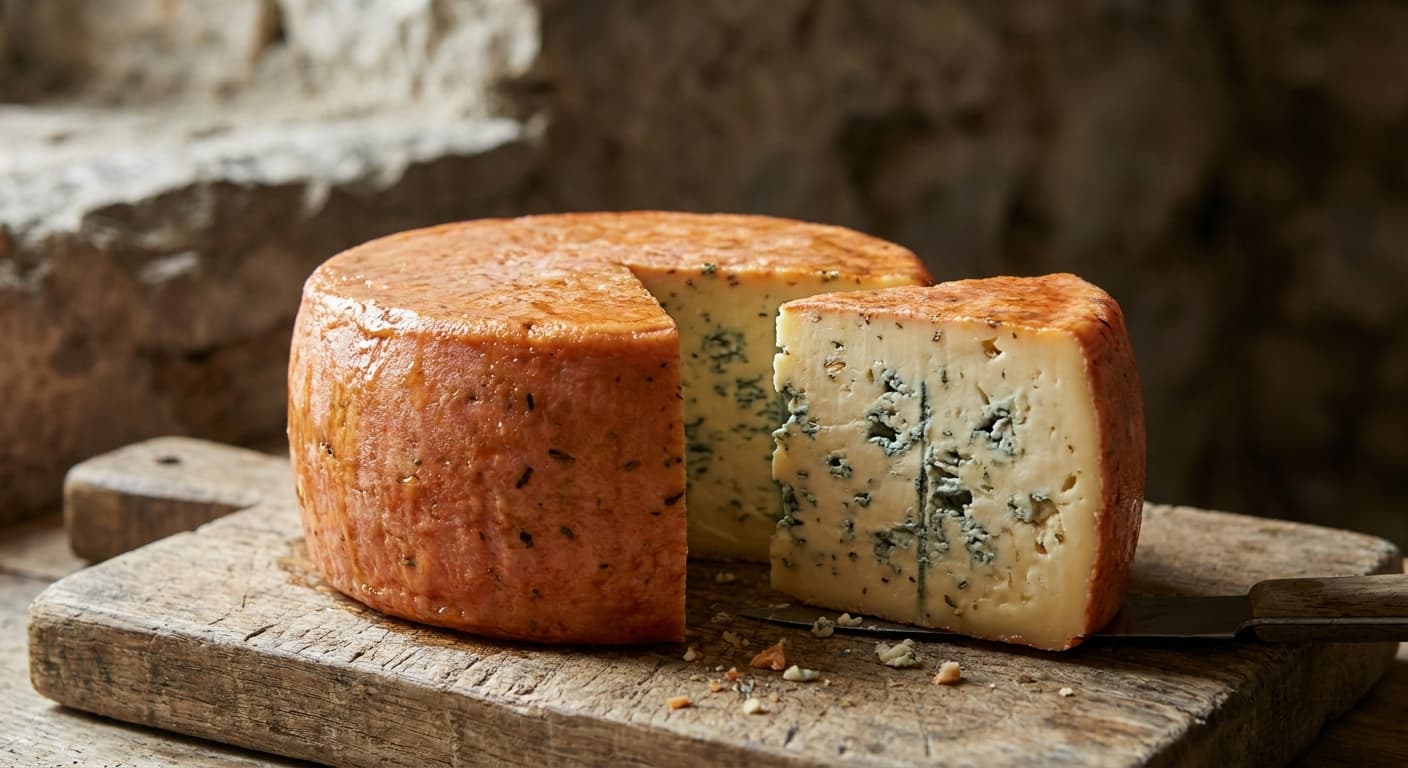
A complex hybrid cheese presenting blue-green veining through a rich, double-cream paste beneath a reddish-orange smear-ripened rind. The interior develops herbaceous, garlicky notes while the surface contributes earthy, barnyard aromatics. Texture ranges from creamy near the rind to more structured in the center, with the high salt content balancing the richness and supporting both blue mold development and surface bacterial activity.
Viability Assessment
This represents an ambitious hybrid concept combining blue cheese development with smear-ripening surface cultures. The technical challenge lies in managing competing microbial environments and the unusually high salt content. While both blue and smear-ripened cheeses can coexist, success depends heavily on precise environmental control and sequential inoculation timing. The concept is achievable but requires advanced technique.
Evaluation breakdown
Scored across five dimensions of cheese viability
The described flavor profile is plausible given the dual microbial systems and high fat content, though the salt level may suppress some complexity.
Managing both blue mold piercing and surface washing simultaneously requires careful timing and environmental control that challenges most artisanal setups.
Blue molds and smear cultures can coexist but compete for resources; high salt content favors surface bacteria while potentially limiting blue development.
Recipe includes necessary cultures for both systems, though success depends on precise execution of environmental conditions and timing.
Unique concept with potential specialty appeal, but the complex flavor profile and strong aromas limit broad market acceptance.
Technical confidence
What's certain vs. what depends on specific maker control
Certain
Chemistry & physics facts — will happen given these inputs.
- •Mesophilic cultures will acidify milk and support curd formation at target temperatures.
- •High salt content (10% of green cheese weight) will create significant osmotic pressure affecting moisture and microbial activity.
- •Double cream fat content will produce a rich, dense paste structure.
- •Animal rennet will achieve clean coagulation and support proper curd formation.
- •Garlic and herbs will contribute aromatic compounds to the paste.
Likely
Probable with reasonable technique and control.
- •Blue veining will develop but may be less extensive due to high salt content and surface competition.
- •Surface will develop orange-red coloration from Brevibacterium linens and associated bacteria.
- •Texture will be creamy to semi-soft with some firmness retention in center.
- •Flavor will be intensely savory with mineral notes from high salt content.
- •Paste color will be pale yellow from cow's milk fat.
Depends on action
Requires deliberate inoculation or specific conditions not in the config.
- •Consistent blue veining requires piercing at 3-4 weeks and maintaining 85-90% humidity with adequate air circulation.
- •Proper smear development requires surface washing with 2-3% salt brine every 2-3 days during first 8 weeks.
- •Balanced dual ripening requires aging at 12-14°C to favor surface cultures while allowing blue development.
- •Even herb and garlic distribution requires thorough incorporation during curd formation without overworking.
Recipe & how to make it
Expected Yield
350-400g finished wheel from 4L double cream milk, accounting for extended aging moisture loss
Mould Size
15cm diameter x 8cm height tomme mould with drainage holes
Salt Method · Precise
10% of green cheese weight applied as dry salt rub after pressing, targeting approximately 40-45g total salt for expected 420-450g green wheel
Ingredients
- •4L whole cow's milk, double cream (6-8% fat)
- •1/8 tsp MA 011 mesophilic culture
- •1/8 tsp Penicillium roqueforti spores
- •Brevibacterium linens surface culture, 1/16 tsp in 50ml sterile water
- •3ml liquid animal rennet (or amount to set milk in 45-60 minutes)
- •2 cloves garlic, finely minced
- •2 tbsp fresh mixed herbs (thyme, rosemary, chives), chopped fine
- •40-45g coarse sea salt for dry salting (10% of expected green cheese weight)
Equipment
- •Large heavy-bottomed pot
- •Long knife for cutting curds
- •Wooden spoon
- •Fine mesh strainer
- •15cm diameter tomme mold with follower
- •Press or weights (up to 5kg)
- •Cheese piercing tool or thick needle
- •Aging cave or controlled environment (12-14°C, 85-90% RH)
Steps
- 1Heat milk to 32°C and maintain temperature.
- 2Add mesophilic culture and P. roqueforti, stir gently and let ripen 45 minutes.
- 3Add diluted rennet, stir for 30 seconds, cover and let set until clean break achieved (45-75 minutes).
- 4Cut curds to 1.5cm cubes, let rest 10 minutes for whey release.
- 5Gradually heat to 38°C over 20 minutes, stirring gently.
- 6Continue stirring until curds shrink and release whey (pH should reach 6.4-6.5).
- 7Drain whey to curd level, gently fold in minced garlic and herbs.
- 8Transfer curds to mold, press at 2kg for 12 hours.
- 9Remove, flip, and press at 4kg for 24 hours.
- 10Remove from press, dry salt all surfaces with measured salt amount.
- 11Age at 12-14°C, 85% RH for 3 weeks, turning daily.
- 12Pierce holes 2cm deep at 2cm intervals across top and sides.
- 13Begin surface washing every 2-3 days with 2% brine and B. linens culture.
- 14Continue aging 13 more weeks, reducing washing frequency to weekly after 8 weeks total.
Critical Checkpoints
- ▸pH at cutting: 6.5-6.6 for proper curd formation
- ▸Curd consolidation: should compact to 60% original volume before pressing
- ▸Green cheese pH after salting: 5.0-5.2
- ▸First piercing at 3 weeks: interior should be firm enough to pierce without cracking
- ▸Surface washing response: orange-red coloration should appear by week 6
The science behind your cheese
Chemistry
Lactic acid fermentation by mesophilic cultures creates the acidic environment necessary for both blue mold enzyme activity and proper casein coagulation. The high salt concentration (10% of cheese weight) creates osmotic stress that selects for halophilic bacteria while moderating proteolysis rates. Garlic's sulfur compounds and herb oils integrate into the fat matrix during curd formation.
Physics
Syneresis expels whey under combined acidification and mechanical pressure, while the high fat content from double cream creates a dense paste structure that retains moisture. Piercing creates oxygen channels essential for blue mold growth, while surface washing maintains the humid microenvironment needed for smear bacteria. Salt migration from surface to center occurs gradually over the 16-week aging period.
Fermentation
The mesophilic starter acidifies milk and creates favorable conditions for P. roqueforti germination after piercing. Brevibacterium linens and associated surface bacteria metabolize lactate and proteins on the rind, producing characteristic orange pigmentation and intense aromatics. Competition between blue molds and surface bacteria for nutrients may limit the extent of blue veining compared to traditional blue cheeses.
Aging Process
Over 16 weeks, proteolysis softens the paste from outside in while lipolysis develops complex flavor compounds. The dual ripening environment requires careful humidity management to prevent either system from dominating. Salt gradually migrates inward, helping preserve the cheese while moderating both blue mold growth and surface bacterial activity.
The cheese playlist
5 songs to listen to while your cheese ages
The electronic complexity mirrors the sophisticated interplay of blue and smear cultures
Celebrates the aromatic garden elements folded into the paste
Captures the vibrant surface development and intensity
References the high mineral content that defines this cheese's character
The extended aging required for both ripening systems to achieve balance
Sommelier's wine pairing
Recommended
Gewürztraminer Late Harvest
Alsace, France
Why it works
The wine's residual sugar and high acidity balance the intense salt and pungent aromatics, while its characteristic spice notes complement the herbs. The richness matches the double-cream texture without being overwhelmed by the complex flavors.
The Science
Sugar molecules bind with salt ions reducing perceived salinity, while the wine's acidity cuts through butterfat and cleanses the palate between bites. Gewürztraminer's terpene compounds harmonize with herb aromatics rather than competing, and the slight sweetness moderates the cheese's intense umami character.
Serving suggestion
Best served at
16-18°C to allow full flavor development while maintaining textural integrity of the dual-ripened structure
Accompaniments
Presentation
Cut into wedges revealing blue veining and orange rind, arranged on slate with accompaniments in small bowls, allowing cheese to reach room temperature 45 minutes before serving
Configuration
The exact parameters used to design this cheese in the Lab.
Members · Export
PDF export is for members
Sign in for free to download the full analysis as a PDF.
Quote · Professor Whiskers
“Ah, the ambitious cheese - wanting to be both blue and orange, like a sunset that can't decide if it's coming or going. At 10% salt, it's practically pickled itself into an existential crisis. Still, I admire its commitment to complexity, even if it did bite off more than most humans can chew.”
— Professor Whiskers, Cheese Philosopher
Community feedback
Sign in to leave feedback or share how your cheese-making attempt went.
No feedback yet. Be the first to share your thoughts!