Author
Cheese Lab
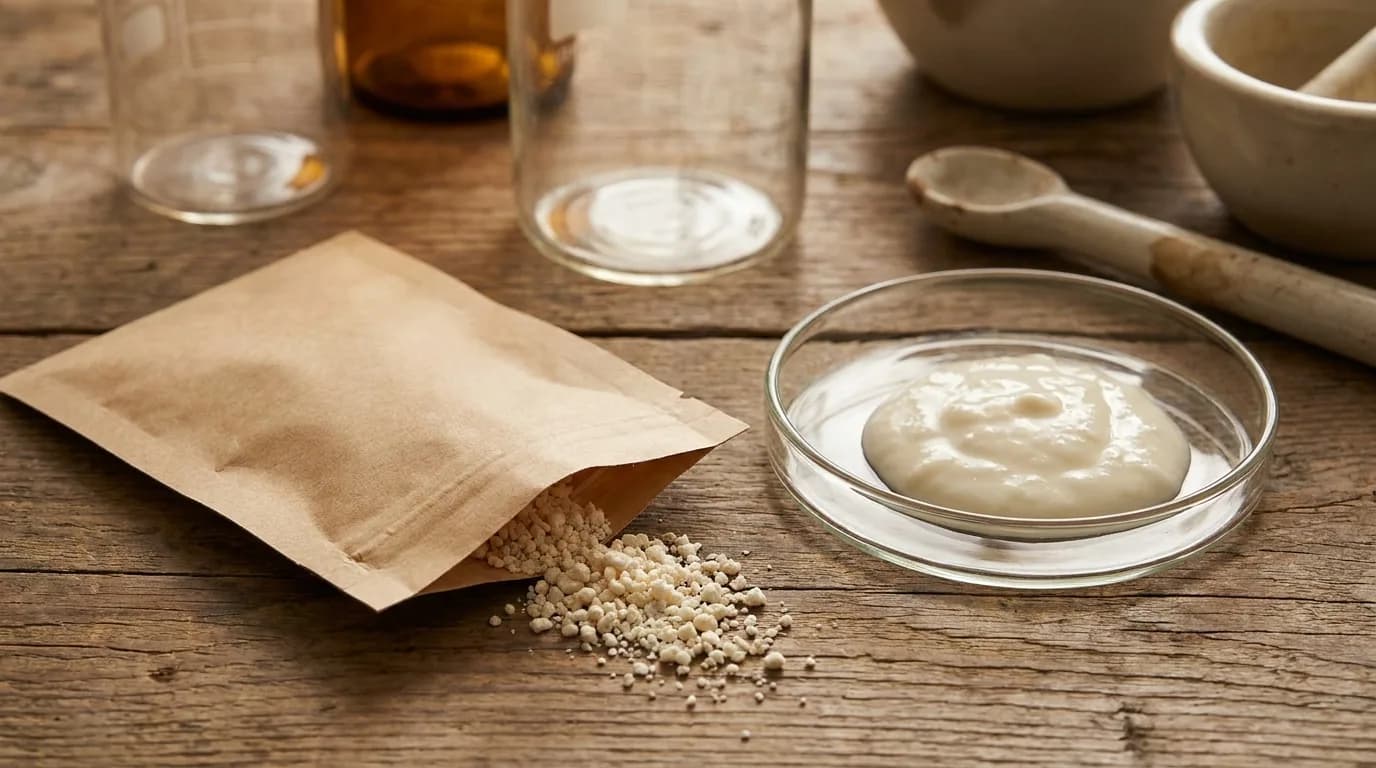
A freeze-dried sachet of direct-set starter looks unimpressive. A light tan powder, a little under a gram, with an expiration date and a batch number. Pour it into warm milk and it disappears. Twenty minutes later the milk starts to acidify; four hours later it has transformed.
Inside that sachet were somewhere between one and ten billion viable cells. Most of them were Lactococcus lactis, a lactic acid bacterium with a genome of about 2.4 million base pairs and a single job: eat the sugar in milk and excrete the acid that starts cheese.
What the starter is actually doing
Lactic acid bacteria (LAB) are not a single organism but a family: Lactococcus, Streptococcus, Lactobacillus, Leuconostoc, and a handful of others. Each genus has its own biochemistry, temperature preferences, and side-products. A starter blend is an ecological choice disguised as a packet.
When the sachet hits milk, the cells rehydrate, wake up, and begin metabolising lactose. Most LAB use a glycolytic pathway called homofermentative fermentation — one glucose becomes two lactic acid molecules, and the cell keeps a small amount of ATP. That is where most of the acidification comes from. Heterofermentative strains (Leuconostoc, some Lactobacillus) run a branching pathway that also produces CO₂, ethanol, and flavour compounds like diacetyl. This is why a starter with Leuconostoc produces a lightly buttery flavour and, in a cheese like Gouda, the small eye-holes.
Why the species choice matters
- Mesophilic blends (Lactococcus-dominant) work at 20–30°C. Cheddar, Brie, Gouda.
- Thermophilic blends (Streptococcus thermophilus + Lactobacillus delbrueckii) work at 35–55°C. Parmesan, Mozzarella, Swiss.
- Adjunct cultures (Lactobacillus helveticus, Propionibacterium freudenreichii) are added not to acidify but to drive specific flavour and eye-forming reactions during ageing.
- Wild starters (kefir grains, raw-milk backslopping) are uncontrolled mixed communities that produce complex regional flavour but inconsistent results.
The molecular genetics have become important in the last two decades. Commercial starter companies sequence their strains, screen for bacteriophage resistance, and publish defined-strain blends so a cheesemaker gets the same biology every time. The days of "a bit of the old milk to start the new" have largely gone commercial.
What to do with that knowledge
Match the starter to the cheese style, not the recipe instructions. A recipe that calls for "mesophilic culture" and a recipe that calls for "MA 4001" are different levels of precision, and the second one produces more reproducible cheese. Pay attention to which adjuncts a recipe specifies. And understand that buying the cheapest generic starter gives generic results.
The Cell Biology of Lactic Acid Bacteria goes deep on the metabolism, genome architecture, and ecological strategies of LAB.
A starter is not a spice. It is a few billion living cells with a job to do.