Sensory Concept
Amber Hills Tomme
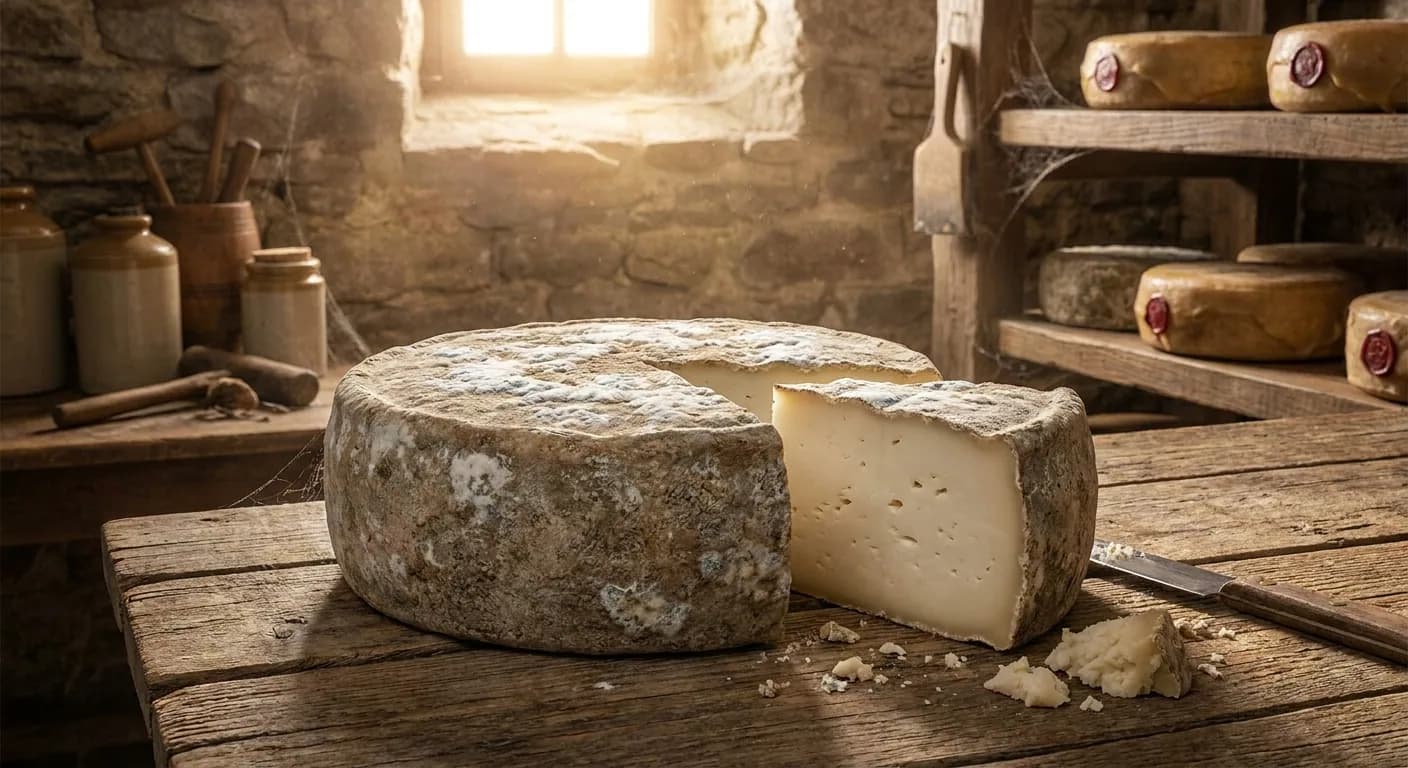
A golden-tinged wheel with a natural grey-brown rind dotted with white and pale blue moulds. The semi-firm paste yields under gentle pressure, revealing a smooth, ivory interior with scattered small eyes. Aromas of cultured butter and toasted nuts give way to a clean, mild tang with hints of grass and cream that build gently across the palate.
Viability Assessment
This configuration represents a technically sound, classic pressed cheese that aligns well with traditional tomme-style approaches. The 16-week aging period allows for proper rind development and flavour maturation without over-complexity. While the concept is sensible and achievable, it tends toward the conventional end of the spectrum rather than offering distinctive market differentiation.
Evaluation breakdown
Scored across five dimensions of cheese viability
The described semi-firm texture, natural rind, and mild nutty character are all plausible outcomes from mesophilic culture, animal rennet, and controlled cellar aging.
This is a straightforward pressed cheese process well within the capabilities of artisanal makers, requiring only standard equipment and established techniques.
Mesophilic culture and animal rennet work harmoniously for this style, though the natural rind development depends on consistent cellar ecology over 16 weeks.
The recipe directly supports the described cheese style, though natural rind character will vary with environmental conditions rather than following a guaranteed path.
A well-executed but conventional cheese that would appeal to traditional cheese enthusiasts, though it lacks distinctive features to command premium pricing or standout recognition.
Technical confidence
What's certain vs. what depends on specific maker control
Certain
Chemistry & physics facts — will happen given these inputs.
- •Mesophilic lactococci will acidify the milk and support proper curd formation.
- •Animal rennet will coagulate casein proteins into a cuttable curd within 45-75 minutes.
- •Pressing will expel whey and create a cohesive cheese wheel suitable for aging.
- •Sixteen weeks of aging will reduce moisture content and develop proteolytic flavour compounds.
- •Salt will migrate throughout the paste and provide preservation hurdles.
Likely
Probable with reasonable technique and control.
- •Semi-firm texture with some flexibility when properly pressed and aged.
- •Natural rind formation with mixed surface moulds under cellar conditions.
- •Mild nutty and grassy flavour development from proteolysis and lipolysis.
- •Pale yellow paste colour from whole milk carotenoids.
- •Approximate yield of 380-450g finished wheel from 4L whole milk.
Depends on action
Requires deliberate inoculation or specific conditions not in the config.
- •Consistent natural rind character requires stable cellar ecology or deliberate surface culture inoculation.
- •Optimal texture development depends on achieving target pH 5.2-5.3 before pressing.
- •Even salt distribution requires proper application technique and adequate pressing time.
- •Proper aging requires maintaining 80-85% humidity and 12-15°C temperature throughout.
Recipe & how to make it
Expected Yield
380-450g finished wheel from 4L whole cow's milk, assuming 10-12% yield after aging
Mould Size
15cm diameter x 7cm height tomme mould with drainage holes
Salt Method · Precise
2.5% of green cheese weight after pressing, applied as dry salt rub to all surfaces before initial drying. For a 450g wheel, use approximately 11g salt.
Ingredients
- •4L whole cow's milk
- •1/8 tsp MA 011 mesophilic culture (or similar Lactococcus lactis blend)
- •4-6ml single-strength liquid animal rennet (adjust based on manufacturer)
- •45-55g coarse sea salt
- •Calcium chloride if using store-bought pasteurised milk (1ml per 4L)
Equipment
- •Large heavy-bottomed pot
- •Long knife for cutting curds
- •Large slotted spoon
- •Fine mesh strainer
- •15cm diameter tomme mould with follower
- •Press or heavy weights (10-15kg capacity)
- •Cheese cloth or muslin
- •Aging space at 12-15°C, 80-85% humidity
Steps
- 1Warm milk to 32°C and add calcium chloride if using pasteurised milk.
- 2Sprinkle culture over milk surface, wait 2 minutes, then stir gently and hold 45-60 minutes until pH drops to 6.4-6.5.
- 3Add diluted rennet, stir for 30 seconds, then maintain temperature and allow to set for 45-75 minutes until clean break achieved.
- 4Cut curd into 1cm cubes and let rest 5 minutes for whey release.
- 5Gradually heat to 38°C over 15-20 minutes while gently stirring curds.
- 6Continue cooking and stirring until curds shrink to rice-grain size and pH reaches 6.2-6.3, typically 30-45 minutes.
- 7Test curds by squeezing - they should hold together briefly then break apart cleanly.
- 8Drain whey to curd level and transfer curds to cloth-lined mould.
- 9Press at 5kg for 4 hours, then flip and press at 10kg for 12 hours, then 15kg for 12 hours.
- 10Remove from press when pH reaches 5.2-5.3 and cheese holds its shape firmly.
- 11Air dry at room temperature for 24-48 hours until surface feels slightly tacky.
- 12Age at 12-15°C and 80-85% humidity, turning daily for first week, then 2-3 times weekly.
- 13Natural moulds should appear within 2-3 weeks - brush lightly if excessive.
Critical Checkpoints
- ▸pH at rennet addition: 6.4-6.5 (typically 45-60 minutes after culture)
- ▸Clean break test: curd splits cleanly when knife inserted and lifted
- ▸Curd texture at draining: rice-grain size, springs back when squeezed then breaks apart
- ▸pH at pressing: 6.2-6.3 when transferring to mould
- ▸pH after pressing: 5.2-5.3 before beginning aging process
The science behind your cheese
Chemistry
Mesophilic Lactococcus lactis converts lactose to lactic acid, lowering pH from 6.7 to approximately 5.2-5.3, which optimises casein aggregation and whey expulsion. Animal chymosin cleaves kappa-casein at the Phe105-Met106 bond, destabilising micelle structure and enabling coagulation. During 16-week aging, residual chymosin and plasmin gradually break down alpha and beta caseins into peptides and amino acids, developing characteristic nutty flavours.
Physics
Syneresis occurs as the protein network contracts under acidification and mechanical stress, expelling moisture-rich whey. Pressing applies external force to accelerate moisture removal and create a cohesive matrix with approximately 45-50% moisture content. Salt migration follows concentration gradients over several weeks, equilibrating throughout the paste while creating water activity barriers against spoilage organisms.
Fermentation
Lactococcus lactis subspecies lactis and cremoris dominate the fermentation, producing primarily lactic acid through homofermentative metabolism. These mesophilic strains also contribute proteolytic enzymes that slowly break down milk proteins during aging, though they remain less active than thermophilic cultures. Limited citrate metabolism may produce small amounts of diacetyl, contributing buttery notes.
Biology · Lactation & Milk
Cow's milk composition reflects the ruminant's complex stomach system, producing casein proteins with high alpha-s1 content that forms strong, elastic curds ideal for pressed cheeses. The fat globule membrane structure and indigenous lipase activity contribute to the development of characteristic bovine cheese flavours during aging. Seasonal variation in pasture access influences carotenoid content, affecting paste colour intensity.
Biology · Microbial
Lactococcus lactis operates through homofermentative glycolysis, efficiently converting lactose to lactic acid while maintaining cell viability throughout early aging phases. These mesophilic organisms possess moderate proteolytic activity through cell envelope proteinases and peptidases, contributing to gradual protein breakdown. Commercial strains are typically phage-resistant selections maintained through rotation programmes to ensure consistent acidification performance.
Biology · Biotechnology
Animal rennet contains authentic calf chymosin extracted from fourth stomach tissue, providing optimal coagulation properties and continued proteolytic activity during aging that contributes to traditional flavour development. Commercial mesophilic cultures represent defined-strain selections of Lactococcus lactis subspecies, standardised for consistent acidification rates and flavour contribution. This traditional combination avoids the modified proteolytic profiles associated with fermentation-produced rennet or accelerated ripening cultures.
Aging Process
Proteolysis proceeds gradually as residual rennet and bacterial enzymes break down casein networks, softening texture and developing umami compounds. Limited lipolysis releases free fatty acids that contribute to nutty and grassy flavour notes. Surface moisture and ambient moulds create a natural rind that regulates further moisture loss while contributing earthy aromatics to the cheese interior.
Safety audit
Biology-driven hazard check for this configuration
Standard pasteurised milk cheese with proper acidification
INFOMechanism: The combination of pH reduction to 5.2-5.3, 2.5% salt content, and controlled aging environment creates multiple hurdles against pathogen growth and survival.
Mitigation: This configuration is inherently well-protected - maintain proper pH targets and aging conditions as specified.
Natural rind development in humid environment
CAUTIONMechanism: Uncontrolled surface moulds in high-humidity aging can occasionally include undesirable species that may affect flavour or, rarely, produce mycotoxins.
Mitigation: Monitor rind development closely, brush away excessive or unusual-coloured moulds, and maintain clean aging environment. Consider inoculating with known Penicillium nalgiovense if consistent rind character is desired.
The cheese playlist
5 songs to listen to while your cheese ages
The gentle, earthy romanticism matches this cheese's honest, pastoral character and patient development
A classic that improves with familiarity, like this traditional style that reveals its depth slowly
Sophisticated simplicity with nuanced variations, reflecting the cheese's subtle complexity
Golden imagery and agricultural nostalgia complement the cheese's sunny paste and farmstead origins
The reliable comfort of a well-crafted standard that never goes out of style
Sommelier's wine pairing
Recommended
Côtes du Rhône Blanc (Marsanne/Roussanne blend)
Southern Rhône Valley, France
Why it works
The wine's moderate acidity and subtle stone fruit character complement the cheese's mild tang without overwhelming its delicate nutty flavours. The wine's medium body matches the semi-firm texture, while shared French terroir traditions create harmonious complexity.
The Science
Marsanne's naturally lower acidity (6-7 g/L tartaric) pairs well with the cheese's buffered pH around 5.3, while the wine's glycerol content enhances perception of the cheese's butterfat. Roussanne's mineral backbone echoes the calcium-rich paste structure, and both components' subtle oxidative notes complement the proteolytic compounds developed during aging.
Serving suggestion
Best served at
Serve at 16-18°C after 30 minutes out of refrigeration to allow the semi-firm paste to soften slightly and release its full aromatic potential
Accompaniments
Presentation
Cut into thin wedges to showcase the natural rind contrast, arrange on wooden board with nuts clustered at center and fruit distributed around the perimeter
Configuration
The exact parameters used to design this cheese in the Lab.
None
Members · Export
PDF export is for members
Sign in for free to download the full analysis as a PDF.
Quote · Professor Whiskers
“Ah, another cheese that thinks aging sixteen weeks makes it sophisticated. I've been napping longer than that. Still, there's something admirably honest about a cheese that doesn't pretend to be anything other than what it is - unlike humans, who age far longer and somehow become less interesting. At least this one develops character over time instead of just wrinkles. *stretches and judges the natural rind with mild approval*”
— Professor Whiskers, Cheese Philosopher
Community feedback
Sign in to leave feedback or share how your cheese-making attempt went.
No feedback yet. Be the first to share your thoughts!